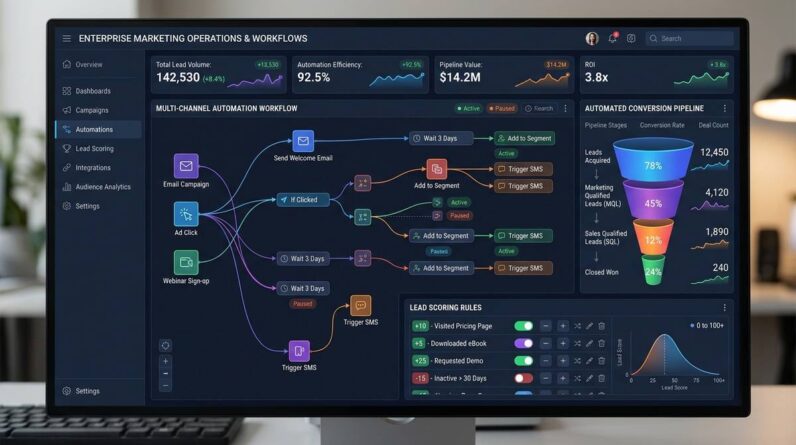
Their analytics dashboards frequently show encouraging vanity numbers: traffic graphs tick upward, impressions climb, social shares accumulate, and organic search impressions expand.
Yet, when the CEO or chief revenue officer asks the only question that truly matters to commercial survival: “How many actual paying customers did this content generate this quarter?” the marketing team is met with awkward silence and defensive stammering.
Traffic is not revenue. Pageviews do not cover company payroll. Social media likes cannot be deposited into a corporate bank account.
Most content marketing fails to generate sales because it is built on a fundamentally flawed premise: the naive belief that if you publish enough generic, top-of-funnel educational content, a magical percentage of those readers will spontaneously hunt down your pricing page and buy your product.
In reality, generic educational content attracts informational tourists: students writing research papers, broke hobbyists looking for free advice, and junior employees gathering notes: people who possess zero purchasing intent and zero corporate budget.
If you want your content marketing to become a predictable, high-yield revenue engine, you must stop creating random acts of content and engineer a Sales-Driven Content Ecosystem.
You must align your editorial calendar directly with the buyer journey, prioritize high-intent bottom-of-funnel conversion assets, weave commercial proof naturally into your educational narratives, and build seamless conversion bridges that guide readers from insight to transaction.
In this comprehensive marketing masterclass, we will explore the economics of revenue-focused content, unpack a three-tier editorial funnel, and walk step by step through creating a content engine that predictably drives pipeline and closes deals.
The Paradigm Shift: Traffic-Driven vs. Revenue-Driven Content
To transform your content results, you must understand the radical philosophical difference between Traffic-Driven Content and Revenue-Driven Content:
Traffic-Driven Content (The Vanity Trap)
- Focus: Chasing massive search volume keywords (e.g., “What is marketing?” or “History of project management”).
- Audience: Casual browsers, students, and broad consumers with zero commercial intent.
- Metrics: Raw pageviews, impressions, and viral social reach.
- Result: A million monthly visitors, a bloated server bill, and five qualified sales leads.
Revenue-Driven Content (The Pipeline Engine)
- Focus: Targeting high-intent commercial keywords and acute customer pain points (e.g., “Best enterprise CRM for logistics companies” or “How to migrate from Salesforce to HubSpot without data loss”).
- Audience: Qualified economic decision-makers actively searching for solutions to urgent business bottlenecks.
- Metrics: Qualified leads, demo requests, pipeline creation, customer acquisition cost, and attributed closed-won revenue.
- Result: Five thousand monthly visitors, twenty high-value enterprise sales inquiries, and hundreds of thousands of dollars in new ARR.
Your goal is not to win the internet popularity contest; your goal is to dominate the commercial search queries that determine vendor selection in your industry.
The 3-Tier Content Funnel Architecture
An elite revenue-generating content engine balances three strategic layers, with an intense, deliberate focus on the bottom of the funnel:
Layer 1: Top-of-Funnel (ToFu) Problem Realization (20% of Effort)
ToFu content targets prospective buyers who are experiencing initial symptoms of a problem but have not yet diagnosed the root cause:
- Example Topic: “Why Your Engineering Team Is Missing Sprint Deadlines.”
- Objective: Frame the problem through your proprietary diagnostic perspective. Help the reader realize that their superficial issue (missing deadlines) is actually driven by a deeper structural flaw (inefficient code review tooling).
- Conversion Action: Offer a high-value diagnostic checklist or whitepaper in exchange for a business email address.
Layer 2: Middle-of-Funnel (MoFu) Solution Comparison (30% of Effort)
MoFu content targets buyers who understand their problem and are actively evaluating different conceptual approaches:
- Example Topic: “In-House Data Pipeline vs. Cloud Data Lake: Cost, Latency, and Maintenance Breakdown.”
- Objective: Educate the reader on the trade-offs of various methodologies while positioning your solution category as the superior architectural choice for their specific use case.
- Conversion Action: Webinar registrations, interactive ROI calculators, and case study whitepapers.
Layer 3: Bottom-of-Funnel (BoFu) Vendor Evaluation and Purchase (50% of Effort)
BoFu content is where ninety percent of all content marketing revenue is captured. Yet, incredibly, most content teams produce virtually zero BoFu content:
- BoFu formats include:
- Direct Competitor Comparison Guides: “Tool A vs. Tool B: A Detailed Feature and Pricing Review for Mid-Market CFOs.”
- Alternative Category Roundups: “Top 7 Competitors to Platform X for Remote Teams.”
- Migration and Transition Guides: “How to Switch from Legacy Vendor to Our Platform in 72 Hours.”
- Industry-Specific Use Cases: “How Regional Banks Use Our API to Automate KYC Compliance.”
- Objective: Address explicit purchasing criteria, dismantle vendor skepticism, highlight competitive superiority, and provide undeniable proof.
- Conversion Action: Direct free trial signups, sales discovery calls, and live product demos.
The “Product-Led” Narrative Blueprint: Weaving Solutions Into Content
One of the most persistent dogmas of old-school content marketing is that blog posts should be strictly neutral, academic, and non-promotional, never mentioning your own product.
This dogma is nonsensical.
If a reader landed on your article titled “How to Fix Broken PostgreSQL Replications,” they have an urgent, burning technical problem. If your software solves that exact problem in three clicks, omitting your solution is doing the reader a profound disservice.
Adopt Product-Led Content:
- The Mechanism of Teaching: Teach the complete, manual step-by-step solution to the problem first. Provide immense, uncompromised educational value.
- Introduce Your Product as the Frictionless Shortcut: Then show how your product automates those manual steps: “You can execute these eight bash terminal commands manually, or you can click this single button in our dashboard to automate replication health checks instantly.”
- Use Real Screenshots and Product Walkthroughs: Display authentic product UI animations and diagrams demonstrating the exact workflow. This trains the prospect on how to use your product before they even create an account.
Distribution Architecture: Turning Content Into Cash Flow
Publishing a great article on your website is only half the battle. Without intentional, multi-channel distribution, your content sits in silence:
1. Internal Sales Enablement (Arming Your Reps)
Your content should be the primary ammunition for your outbound sales reps and account executives:
- When a prospect on a sales call expresses hesitation about implementation timelines, the sales rep should immediately follow up with: “Our VP of Engineering actually wrote a comprehensive breakdown on how we handled this exact deployment for a Fortune 500 client. Here is the link.”
- Equipping reps with relevant BoFu content shortens sales cycles and builds immense institutional credibility.
2. High-Converting Email Nurture Sequences
Do not dump new subscribers into a generic monthly newsletter. Route them through an automated five-part welcome sequence:
- Email 1: Deliver promised asset and challenge conventional wisdom.
- Email 2: Share your founder origin story and core philosophy.
- Email 3: Dissect a major client case study transformation.
- Email 4: Answer the top five objections prospective buyers raise.
- Email 5: Direct invitation to book a discovery call or claim an exclusive trial offer.
3. Search Engine Optimization for Commercial Intent
Conduct rigorous keyword research focusing on search intent rather than raw volume:
- Target long-tail keyword queries containing intent modifiers: “best,” “pricing,” “alternatives,” “software for,” “how to choose.”
- A keyword with two hundred monthly searches and high commercial intent will generate ten times more revenue than a broad keyword with fifty thousand monthly searches.
Attribution and Analytics: Measuring True Content ROI
To justify your marketing budget and continuously optimize your editorial calendar, implement multi-touch revenue attribution:
- Track First-Touch and Last-Touch Conversions: Identify which articles first introduced customers to your brand (pipeline builders) and which specific articles they read immediately prior to booking a sales call (deal closers).
- Self-Reported Attribution: Add a simple, open-ended question to your demo intake form: “How did you first hear about us?” You will be amazed how often enterprise buyers write: “I read your comparison article on LinkedIn” or “Your guide on database indexing solved our production bug.”
Advanced Content Governance: Building a Sustainable Editorial Machine
To ensure your sales-driven content marketing strategy produces consistent, compounding revenue quarter after quarter, establish these organizational disciplines:
1. The Weekly Customer-Facing Feedback Loop
Schedule a bi-weekly thirty-minute synchronization meeting between your content creators and customer-facing teams (sales development reps, account executives, and customer support agents). Ask two fundamental diagnostic questions:
- What specific questions or objections did prospective buyers raise on calls this week?
- What industry misconceptions or competitor claims caused confusion during demos?
Use the direct answers to these questions to fuel your bottom-of-funnel editorial calendar.
2. Comprehensive Content Refresh and Pruning Cycles
Every six months, conduct an audit of your existing content library. Update outdated statistics, refresh obsolete product screenshots, replace dead hyperlinks, and optimize underperforming articles that hover on pages two or three of search engine results. Refreshing existing high-potential content frequently generates a faster return on investment than writing brand-new articles from scratch.
3. Multi-Channel Repurposing Workflows
Never publish a high-value piece of cornerstone research and leave it stranded on your blog. Deconstruct every long-form article into a comprehensive content atomization pipeline:
- Extract three tactical text posts for executive LinkedIn profiles.
- Transform key data comparisons into a visual infographic for social channels.
- Adapt the core case study into a dedicated email newsletter for your subscriber list.
- Record a short five-minute video walkthrough breaking down the primary framework.
Conclusion: Stop Blogging for Clicks, Start Writing for Revenue
Content marketing is not an artistic hobby; it is a customer acquisition channel.
Stop measuring your success by empty vanity metrics that impress social media algorithms but starve your company bank account. Focus your energy on the high-intent buyers who are actively searching for solutions to their most painful problems.
Diagnose their obstacles with empathy. Provide masterclass-level education. Position your product as the natural, high-leverage mechanism of change, and make taking the next commercial step irresistible.
When you align your content strategy with real customer buying journeys, your content stops being a marketing expense and transforms into the most profitable sales asset in your entire company.