For most business owners, launching a company website feels like reaching the finish line. You invest weeks working with designers, agonizing over color palettes, polishing paragraph copy, and testing mobile responsiveness. The day your site finally goes live, there is a tangible surge of pride. You picture qualified prospects discovering your brand, reading through your services, and reaching out to work with you.
Then reality sets in. Days pass, followed by weeks and months. You log into your analytics dashboard and notice that people are indeed landing on your site. Yet, your inbox remains quiet. The contact form gathers dust, the phone rarely rings, and your sales team continues hunting for cold leads manually.
What went wrong? The truth is that most business websites are built as passive online digital brochures. They display information about who you are, what you sell, and where you are located. But modern online visitors do not visit websites to read company brochures. They arrive with pressing problems, urgent questions, and short attention spans. If your website does not actively capture their interest, offer immediate value, and guide them along a clear path, they will leave within seconds and never return.
A high-performing website must function as a tireless digital salesperson. It should welcome visitors around the clock, diagnose their challenges, deliver genuine value, qualify their intent, and seamlessly capture their contact information while you sleep.
Transforming an underperforming web presence into an automated lead generation machine does not require an expensive rebrand or complex coding. It requires adopting a systematic conversion framework. In this comprehensive guide, we will unpack the foundational mechanics of high-converting websites and explore the exact operational steps needed to turn casual browsers into booked appointments and qualified sales leads.
The Paradigm Shift: From Passive Brochure to Active Conversion Engine
To build a website that generates consistent inbound leads, you must first abandon the brochure mentality. A brochure is static; a conversion engine is dynamic and interactive.
When a visitor lands on a traditional business website, they are typically greeted by generic marketing slogans such as “Excellence in Service” or “Your Trusted Global Partner.” Below that sits a generic paragraph about the company history, followed by a list of technical services. In the top corner, there is a lonely button that reads “Contact Us.”
Consider the psychology of the visitor. That person likely searched for a solution to an immediate headache. They do not yet know you, like you, or trust you. Asking them to click “Contact Us” or fill out an eight-field form on their first visit is the digital equivalent of proposing marriage on a first date. The friction is too high, the relationship is unearned, and the perceived risk outweighs the reward.
An active conversion engine operates on a completely different psychological premise. It acknowledges that over ninety percent of your first-time website visitors are not ready to purchase today. Instead of forcing an immediate sales conversation, the conversion engine focuses on initiating a relationship. It provides targeted value in exchange for permission to continue the dialogue.
Every page, element, and paragraph on your website must serve one of three foundational purposes:
- Attracting and orienting the ideal prospect by speaking directly to their specific pain point.
- Building indisputable trust and authority through education, proof, and clarity.
- Offering low-friction opportunities to exchange contact details for high-value resources.
When these three elements work together harmoniously across your digital footprint, your website stops being a cost center and becomes your most reliable revenue asset.
1. Crafting Above-the-Fold Messaging That Commands Attention
Human beings make subconscious judgments about digital interfaces within fifty milliseconds. When someone visits your homepage or landing page, the immediate area visible before scrolling, commonly known as above the fold, determines whether they stay or bounce.
To command attention and prevent immediate exits, your headline must answer three vital questions in under five seconds:
- What specific problem do you solve?
- Who exactly do you solve it for?
- What should the visitor do next?
Most companies fail this test by writing headlines focused entirely on themselves. Replace self-centered statements with customer-centric value propositions. For example, instead of writing “We Offer Premier B2B Financial Consulting,” write “We Help Mid-Sized Manufacturing Companies Cut Supply Chain Overhead by 20% Without Layoffs.”
Notice the stark contrast. The second headline instantly qualifies the reader, quantifies the tangible business outcome, addresses a primary anxiety, and sparks genuine curiosity.
Pair this clear headline with an active sub-headline that elaborates on your methodology, followed immediately by a prominent primary call to action button. Ensure your background imagery supports the message rather than distracting from it. Avoid rotating image carousels or auto-playing video backgrounds with sound, as usability studies consistently show they degrade comprehension and lower conversion rates.
2. Designing Irresistible Lead Magnets That Prospects Will Gladly Trade Data For
If ninety percent of your visitors are browsing rather than buying, you need an ethical bribe to capture their email address. This asset is known as a lead magnet.
Many businesses slap a generic box on their sidebar that says “Subscribe to Our Newsletter.” In the modern era of inbox overload, nobody wants another generic company newsletter. To persuade a busy professional to surrender their primary email address, your lead magnet must provide specific, immediate, and actionable value.
The most effective lead magnets solve a narrow problem quickly. Rather than offering a comprehensive eighty-page theoretical ebook that will sit unread in a downloads folder, create high-utility tools:
- Specific Checklists and Audits: A twenty-point self-diagnostic worksheet that helps prospects assess their current system vulnerabilities or operational efficiency.
- Proprietary Calculators and Spreadsheets: A customizable financial model or pricing estimator that gives prospects instant numerical clarity.
- Actionable Video Masterclasses: A concise fifteen-minute video teardown showing exactly how you resolved a complex industry dilemma.
- Resource Toolkits and Templates: Pre-built design templates, copy formulas, or workflow cheat sheets that save the prospect hours of manual labor.
The key to a high-converting lead magnet is high perceived value and rapid consumption. When a prospect downloads your tool, uses it within ten minutes, and experiences a genuine breakthrough, they immediately perceive your brand as an indispensable partner.
3. Streamlining Forms to Minimize Conversion Friction
Once a visitor decides they want your resource, the form they encounter will make or break the conversion. Form friction is one of the silent killers of digital lead generation.
Every additional input field you demand on a form increases cognitive load and drops completion rates. If you are offering a top-of-funnel educational checklist, you rarely need more than a first name and a work email address. Demanding phone numbers, physical mailing addresses, company revenue figures, and job titles at this early stage introduces unnecessary resistance.
When your sales process requires deeper qualification, consider adopting multi-step forms rather than one massive, intimidating wall of inputs. Psychological research demonstrates the power of the foot-in-the-door phenomenon: when people take a small, effortless initial step, they feel a subconscious desire to finish what they started.
A modern multi-step form begins with a simple, non-threatening multiple-choice question, such as “What is your primary marketing goal for this quarter?” After the user clicks an option, the form smoothly transitions to the next screen. By the time they reach the final step asking for contact details, they have already invested effort and are far more likely to complete the submission.
Furthermore, pay close attention to your submit button copy. Generic button text like “Submit” or “Click Here” triggers hesitation. Replace passive text with benefit-driven microcopy that reinforces the reward: “Send Me the Free Guide,” “Get Instant Access,” or “Claim My Growth Audit.”
4. Incorporating Strategic Social Proof and Trust Anchors
Prospects arriving at your website are naturally skeptical. They have been burned by exaggerated claims, overpromised services, and aggressive sales pitches in the past. To turn your website into a credible lead generator, you must weave authentic proof mechanisms into the fabric of every page.
Social proof should not be isolated on a separate, hidden “Testimonials” page that nobody visits. Instead, distribute proof strategically beside every major claim and call to action:
- Client Case Studies with Specific Metrics: Vague praise like “They did a fantastic job” carries minimal persuasive weight. Highlight concrete results: “How We Helped Alpha Logistics Boost Inbound Freight Inquiries by 142% in 90 Days.”
- Recognizable Logos and Certifications: Display clean monochrome logos of notable companies you have served, reputable industry associations you belong to, or media publications that have featured your work.
- Video Testimonials: Raw, authentic video snippets from real founders and department heads discussing the specific before-and-after reality of partnering with your firm.
- Real-Time Activity Proof: Subtle, non-intrusive notification badges indicating recent downloads or consultation bookings show that other peers are actively taking action.
When your claims are consistently validated by third-party peers, the perceived risk of engaging with your company evaporates.
5. Implementing Intelligent Engagement Mechanisms
A truly automated lead generation machine does not just wait for visitors to stumble upon forms; it engages them proactively based on their real-time browsing behavior.
Modern marketing automation tools allow you to deploy contextual triggers that offer assistance at the exact moment a prospect demonstrates high intent:
- Exit-Intent Overlays: When mouse tracking software detects that a desktop user is moving their cursor toward the browser’s back button or closing tab, trigger a polite overlay offering your most valuable diagnostic resource before they leave.
- Scroll-Depth Triggers: When a reader scrolls through seventy percent of an educational blog article on SEO, slide in a subtle slide-in box suggesting a related, downloadable checklist on keyword architecture.
- Conversational Chatbots and Live Routing: Embed intelligent, lightweight chat modules that ask visitors simple diagnostic questions. An automated bot can qualify whether the visitor is an enterprise buyer or a small startup, answer frequently asked logistical questions, and immediately present a calendar booking link for qualified accounts.
The objective of behavioral automation is not to pester visitors with annoying popups, but to offer timely, contextually relevant assistance when they have demonstrated authentic interest.
6. The Post-Capture Sequence: Automated Nurturing
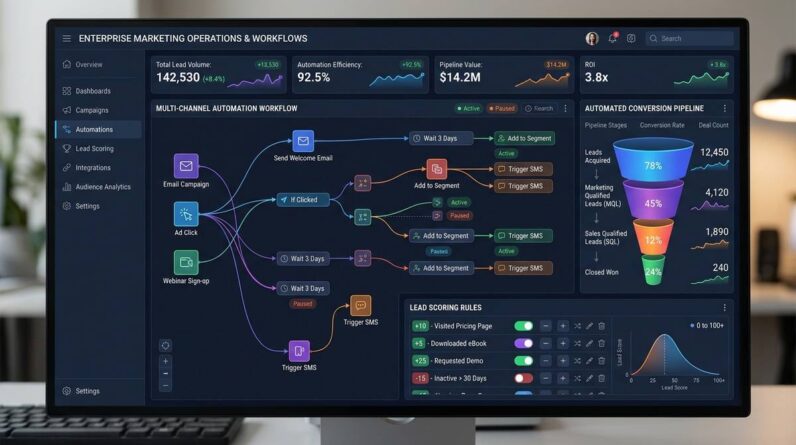
Capturing an email address is only the first chapter of the lead generation story. A captured lead who receives zero follow-up is an asset that rapidly depreciates. To complete your automated machine, you must connect your website forms to a disciplined, multi-day automated email welcome sequence.
The moment a prospect submits their information, your email service provider should instantly dispatch the requested asset within sixty seconds. The initial email should be brief, warm, and helpful, confirming delivery and encouraging the recipient to open and apply the material.
Over the subsequent seven to ten days, your automated system should send four to five carefully constructed nurture emails:
- Day 2 (The Origin Story and Core Insight): Share the counterintuitive lesson or practical mistake that led you to develop your signature methodology.
- Day 4 (The Deep-Dive Case Study): Walk step-by-step through how an actual client faced the identical frustration the prospect is currently experiencing and overcame it using your framework.
- Day 6 (The Common Pitfalls Breakdown): Educate the prospect on the three most common mistakes people make when trying to resolve this issue alone, positioning your team as the trusted guide.
- Day 8 (The Direct Invitation): Extend a clear, low-pressure invitation to schedule a diagnostic strategy session, audit, or discovery call to map out a tailored execution plan.
By automating this educational sequence, your website warms up cold traffic, establishes your authority, and delivers pre-sold, educated prospects directly to your sales team calendar without requiring a single minute of manual manual outreach.
7. Continuous Conversion Rate Optimization
Building a 24/7 lead generation engine is not a one-time project; it is an ongoing discipline of measurement, testing, and refinement. Even minor enhancements to your conversion rate yield exponential revenue returns over time.
Begin by establishing clear baseline metrics in your web analytics platform. Track your overall sitewide conversion rate, the performance of individual landing pages, and the specific drop-off points within your forms. Utilize session recording software and visual heatmaps to observe where visitors click, where they hesitate, and where they lose interest.
Once you have established reliable baseline data, implement disciplined split-testing (A/B testing) protocols. Test one variable at a time so you can isolate causation:
- Test bold, outcome-oriented headlines against pain-focused headlines.
- Test short-form landing pages against comprehensive long-form sales pages.
- Test contrasting button colors and revised call-to-action microcopy.
- Test removing non-essential navigation links from dedicated landing pages to keep visitors focused entirely on the primary offer.
By committing to incremental, data-backed optimizations every month, you compound your marketing efficiency. A website that converts two percent of its visitors can be systematically tuned to convert four or five percent, effectively doubling your inbound pipeline without spending an extra dollar on traffic generation.
Conclusion: Activating Your Digital Sales Engine
In the competitive landscape of modern digital commerce, relying on word of mouth or passive brochure websites is a precarious growth strategy. Your competitors are actively capturing the attention of your prospective buyers every single day.
By shifting your mindset, crafting compelling above-the-fold messaging, deploying valuable lead magnets, eliminating form friction, displaying authentic proof, and automating your follow-up workflows, you build an enduring digital asset. Your website ceases to be an expense and transforms into a reliable, predictable engine that captures attention, earns trust, and fuels your company growth twenty-four hours a day, seven days a week.