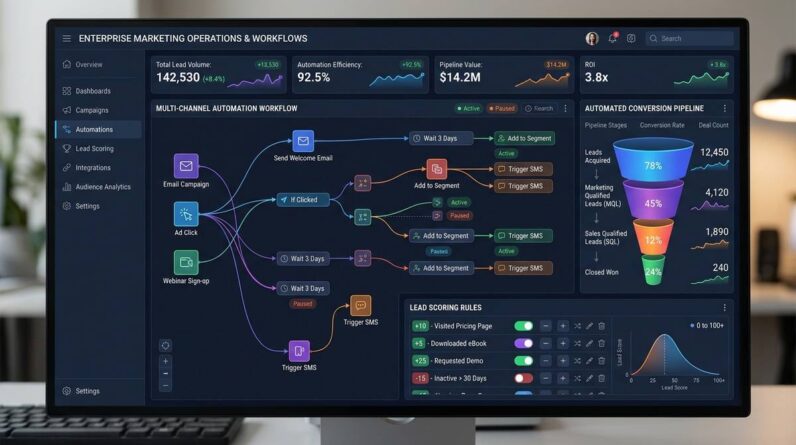
The Exhausting Myth of Manual Marketing Hustle
In the early days of building a business, manual effort is your greatest asset.
You personally send every outreach email, hand-craft every sales proposal, manually follow up with every prospective lead, and manually update spreadsheet records after every phone call. This high-touch, hands-on hustle is essential for learning what your customers truly care about.
However, as your business grows past a critical threshold, manual hustle transforms from your greatest strength into your most dangerous operational bottleneck.
Marketing managers and founders find themselves trapped on a relentless administrative treadmill:
– Leads submit forms on your website at 8:00 PM on Friday, but nobody follows up until Monday afternoon, by which time eighty percent of leads have hired a competitor.
– Promising prospects download an educational guide, receive zero follow-up nurture, and completely forget who you are within two weeks.
– Sales reps spend sixty percent of their working day manually typing notes, setting calendar reminders, and tagging contacts instead of having high-value sales conversations with qualified buyers.
The business hits a hard revenue ceiling. To get more customers, you have to hire more expensive administrative staff, which drives up overhead and crushes profit margins.
The antidote to this operational paralysis is Marketing Automation.
Marketing automation is not about blasting spam or sending cold, robotic emails to unsuspecting strangers. True marketing automation is about building intelligent, responsive digital infrastructure that delivers the right message, to the right person, at the exact moment of maximum psychological receptivity, twenty-four hours a day, seven days a week, without requiring human intervention.
Here is your comprehensive playbook to designing, implementing, and optimizing a marketing automation engine that generates predictable leads and accelerates sales pipeline velocity.
The 4 Core Pillars of Enterprise Marketing Automation
To build an automated growth machine, your technology stack and operational workflows must be organized around four foundational pillars:
Pillar 1: Dynamic Lead Capture and Enrichment
When a prospect interacts with your digital ecosystem, automation immediately captures their intent data. Beyond a simple name and email address, modern enrichment tools (such as Clearbit or ZoomInfo APIs) automatically append critical firmographic data: company size, industry sector, job title, and technology stack.
Pillar 2: Behavioral Tracking and Intent Scoring
Automation allows you to track exactly how each prospect interacts with your brand. Did they visit your pricing page three times this week? Did they watch eighty percent of your product demo video? Did they open your last four case study emails? Every meaningful interaction adds points to their Lead Score.
Pillar 3: Adaptive Multi-Channel Nurturing
Rather than sending identical, linear email newsletters to your entire database, automation routes prospects down personalized nurture branches based on their behavior, industry, and role.
Pillar 4: Seamless Sales Pipeline Hand-Off
The moment a prospect crosses an established Lead Score threshold, the system triggers real-time alerts. It notifies the appropriate sales executive via Slack or CRM notification, schedules an automated calendar invitation, and pre-populates a briefing document with the prospect’s complete interaction history.
Building the High-Converting Lead Magnet and Nurture Funnel
The foundation of marketing automation is capturing contact information in exchange for high-value intellectual property.
Step 1: The Specific, High-Utility Lead Magnet
Avoid vague, thirty-page generic eBooks that nobody reads. Create a tight, actionable resource that solves one acute problem immediately:
– A customizable financial modeling spreadsheet.
– An interactive audit scorecard or diagnostic quiz.
– A one-page standard operating procedure (SOP) checklist.
Step 2: The Instant Automated Welcome Sequence
The first sixty minutes after an opt-in represents the peak moment of customer attention. Deploy an automated four-part Welcome and Trust Sequence:
– Email 1 (Immediate Delivery): Deliver the requested asset instantly. Set expectations for what they will learn from your brand and ask a simple, open-ended question to encourage a direct reply (which boosts email deliverability).
– Email 2 (Day 2 – The Origin and Philosophy): Share the counter-intuitive breakthrough or customer story that inspired your methodology.
– Email 3 (Day 4 – The Core Case Study): Walk through a detailed, metrics-backed breakdown of how a client achieved massive success using your framework.
– Email 4 (Day 6 – The Soft Invitation): Invite the reader to take the next commercial step: scheduling a discovery call, signing up for a free trial, or purchasing a starter product.
Mastering Lead Scoring: Separating Browsers from Buyers
One of the biggest complaints from sales teams is that marketing delivers hundreds of unqualified leads who have zero budget and zero intent to buy.
Lead Scoring solves this friction permanently by scoring leads across two distinct dimensions:
Dimension 1: Explicit Fit (Who They Are)
Assign positive points for matching your Ideal Customer Profile (ICP):
– VP or C-Level Job Title: +20 Points
– Enterprise Company Size (50+ Employees): +25 Points
– Target Industry Sector: +15 Points
– Student or Gmail/Yahoo Address: -30 Points
Dimension 2: Implicit Engagement (What They Do)
Assign points based on digital buying signals:
– Visiting the Enterprise Pricing Page: +25 Points
– Downloading a Technical Comparison Guide: +15 Points
– Watching an On-Demand Product Demo: +20 Points
– Unsubscribing or Inactivity for 60 Days: -25 Points
The Automation Trigger:
Establish a Sales-Qualified Lead (SQL) threshold (e.g., 75 Points). When a lead reaches 75 points, the automation immediately assigns the lead to an account executive and triggers an automated, personalized outreach sequence from the rep’s direct inbox.
5 Essential Automation Workflows Every Business Must Deploy
To maximize revenue impact, implement these five battle-tested automated workflows:
Workflow 1: The Rapid Response Inbound Trigger
– Trigger: A prospective customer submits a contact or demo request form on your website.
– Automated Action: An automated webhook sends a personalized SMS and email confirmation within ninety seconds. If during business hours, it connects the lead directly to an available representative via automated outbound dialing. Leads responded to within five minutes are twenty-one times more likely to enter the sales pipeline than those contacted after thirty minutes.
Workflow 2: The Abandoned Browse / Cart Recovery Flow
– Trigger: A registered user or lead visits your pricing or checkout page, lingers for two minutes, and exits without buying.
– Automated Action: Twenty-four hours later, the system sends an empathetic, helpful email: ‘Hi Sarah, I noticed you were looking over our enterprise tiers yesterday. Did you have any questions about implementation or custom integrations? Here is a two-minute video answering our top five onboarding questions.’
Workflow 3: The Event / Webinar Engagement Sequence
– Trigger: A prospect registers for a live educational masterclass.
– Automated Action: Delivers automated countdown reminders at 24 hours, 1 hour, and 10 minutes prior to broadcast with direct join links. Post-event automation branches based on attendance: attendees receive the recording and a direct offer; non-attendees receive a condensed summary and an invitation to the next session.
Workflow 4: The Customer Onboarding and Activation Engine
– Trigger: A new client signs a contract or purchases a software subscription.
– Automated Action: Instantly generates user credentials, triggers a personalized welcome video from the CEO, schedules an onboarding milestone call, and sends an automated five-day drip tutorial teaching them how to achieve their first quick win.
Workflow 5: The Dormant Lead Re-Engagement Campaign
– Trigger: A contact in your database has not opened an email, visited your website, or engaged with content for ninety days.
– Automated Action: Sends a provocative, low-friction re-engagement email with an irresistible subject line: ‘Should I close your file?’ or ‘Are you still focused on reducing customer acquisition costs this quarter?’ Those who reply are re-activated; those who remain inactive are automatically scrubbed from your list to maintain pristine sender deliverability.
Choosing Your Marketing Automation Tech Stack
Selecting the right software depends on your operational complexity and business model:
For Small to Mid-Sized Businesses and Solopreneurs:
– ActiveCampaign or ConvertKit (Kit): Exceptional visual automation builders, outstanding deliverability, affordable pricing, and seamless integrations with e-commerce and landing page builders.
For Growing B2B Scaling Enterprises:
– HubSpot: The gold standard for integrated marketing, sales, and service automation. Features intuitive lead scoring, robust pipeline management, and world-class reporting dashboards.
For High-Volume Enterprise Organizations:
– Marketo (Adobe Experience Cloud) or Salesforce Marketing Cloud: Massive enterprise power designed for complex multi-tier organizations managing millions of consumer records across global divisions.
Crucial Automation Pitfalls to Avoid
Automation is a force multiplier: it makes great marketing immensely profitable, and it makes bad marketing annoyingly offensive.
Avoid these critical mistakes:
– The Robot Voice Trap: Writing cold, clinical, hyper-corporate copy that sounds like it was generated by a database algorithm. Write every automated email as if you were writing a personal one-on-one message to a respected friend.
– Over-Automating Human Moments: Never automate high-stakes empathy. When a customer has an urgent billing dispute or an upset client reaches out, route them immediately to a warm, empowered human being.
– Set-It-and-Forget-It Neglect: Automation workflows require regular maintenance. Review your conversion funnels, test your form webhooks, and refresh outdated case study links every ninety days.
Conclusion: Engineering Sustainable Scale
Marketing automation is ultimately about one thing: liberating your human talent from repetitive administrative drudgery so they can focus on high-impact strategic creativity and deep customer relationships.
When you install an intelligent, automated marketing engine, your business operates with relentless consistency.
Leads are nurtured while you sleep, qualified prospects are routed to sales reps within minutes, customers are onboarded flawlessly, and your revenue pipeline compounds with predictable mathematical precision.
Stop burning out on manual marketing tasks. Build your automation infrastructure today, and watch your business scale with effortless momentum.
Multi-Touch Attribution Integration with CRM Pipelines
The true commercial power of marketing automation is realized when your automated workflows communicate directly with your enterprise Customer Relationship Management (CRM) platform.
In modern B2B sales cycles, the customer journey is rarely linear. A prospective enterprise client might read three organic blog posts in January, download a technical white paper in February, attend a live virtual masterclass in April, and finally book a sales discovery call in June.
By configuring multi-touch marketing attribution within your automation engine, your executive team gains total visibility into every digital touchpoint that influenced the deal.
Key Attribution Models to Configure:
– First-Touch Attribution: Identifies which top-of-funnel marketing asset originally introduced the lead to your brand ecosystem.
– Lead-Creation Touch: Identifies the exact offer or webinar that convinced the prospect to surrender their email address.
– Opportunity-Creation Touch: Identifies the final automated nurture email or case study that persuaded the prospect to schedule a live sales call.
Armed with clean attribution data, marketing leadership stops guessing which campaigns drive revenue and confidently allocates capital toward the specific automation workflows that generate verified enterprise pipeline.