I once spent three months building a product that nobody bought. The product was good. The marketing was decent. The price was reasonable. But the offer was forgettable. It was a thing for sale, not an invitation to something better. When I finally understood the difference between a product and an offer, everything changed.
A product is what you sell. An offer is what someone actually buys. And those are not the same thing.
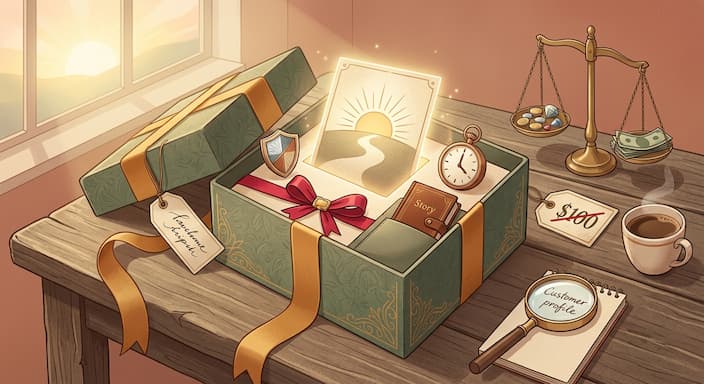
Let me explain what I mean. A product is a set of features and capabilities. An offer is the complete package: the outcome you’re promising, the price you’re asking, the guarantee you’re standing behind, the bonuses that sweeten the deal, the urgency that makes now the right time, and the story that makes it all make sense.
Most businesses compete on product. The ones that win compete on offer.
Why the Offer Matters More Than the Product
In a world where almost every product can be copied and commoditized, the offer is where differentiation actually lives.
Two businesses can sell nearly identical products. One struggles to get customers. The other can’t keep up with demand. The difference is rarely the product itself. It’s the offer.
Consider a simple example. Two consultants offer the same service: a one-hour strategy session. The first charges $200 for “a one-hour strategy call.” The second charges $500 for “a 90-minute deep-dive where we map your next quarter, record the call for your reference, and follow up with a written action plan within 48 hours.”
The second offer costs more than double. And it’s almost certainly easier to sell. Why? Because it’s not just a call. It’s an outcome, a deliverable, and a safety net all wrapped together.
When you understand this, you stop asking “How do I convince people to buy?” and start asking “How do I make buying the obvious choice?”
The Core Components of an Irresistible Offer
Every compelling offer contains several key elements. Not all offers include every element, but the strongest ones do. Let’s walk through them.
1. A Clear, Desirable Outcome
People don’t buy products. They buy outcomes. They buy the after state—what their life looks like once the problem is solved.
The strongest offers lead with the outcome, not the process. Not “a 12-module course on copywriting” but “write copy that converts visitors into customers.” Not “a meal planning app” but “eat healthy without thinking about it.”
The outcome should be specific enough to be believable and desirable enough to be worth paying for.
2. A Specific Target Audience
An offer for everyone is an offer for no one. The more specifically your offer speaks to a particular person’s situation, the more irresistible it becomes to that person.
“This is for freelance designers who want to raise their rates without losing clients” is infinitely more compelling to a freelance designer than “this is for creative professionals.”
The specificity doesn’t just make the offer more attractive to the right person. It also makes it more believable. When you describe someone’s exact situation, they trust that you understand their problem.
3. The Price
Price is not a number. It’s a story.
The same price can feel expensive or like a steal, depending on how you frame it. A $500 course feels expensive if it’s just a course. It feels like an investment if it promises to help someone earn $5,000 more this year.
Price framing matters. Compare the cost to the alternative: the cost of not solving the problem, the cost of a competitor’s solution, the cost of doing nothing. When you frame the price against the value of the outcome, it becomes easier to justify.
4. Bonuses That Enhance the Core Offer
Bonuses work best when they solve the customer’s next problem. They shouldn’t be random extras. They should be natural extensions of the core offer that remove friction from the customer’s journey.
If you sell a course on starting a blog, a bonus on “how to get your first 100 subscribers” makes sense. A bonus on “advanced SEO” might be too advanced for a beginner. The bonus should match where the customer is now, not where they’ll be in a year.
5. A Risk-Reversing Guarantee
The guarantee is where many businesses get timid. They offer a 30-day money-back guarantee and call it done. But a weak guarantee does little to overcome the fear of buying.
A strong guarantee reverses the risk. It says: if this doesn’t work for you, you don’t pay. Or: if you don’t see results within X days, we’ll refund you and let you keep the bonuses. Or: we’ll work with you until you get the result, or we’ll refund every penny.
The stronger the guarantee, the more confident the buyer feels. And confidence is what moves people from hesitation to action.
6. Urgency and Scarcity (When They’re Real)
Urgency and scarcity are powerful motivators. But they only work when they’re genuine. Fake countdown timers and manufactured scarcity erode trust and damage your reputation.
Real urgency sounds like: “Enrollment closes Friday because we start the live cohort on Monday.” Real scarcity sounds like: “I can only take five new clients this month because of my current workload.”
When urgency and scarcity are authentic, they help people make a decision they already want to make. When they’re manufactured, they backfire.
7. A Story That Makes It Make Sense
The final component is the narrative. Why does this offer exist? Why now? Why you?
The story connects everything else. It explains the problem, validates the frustration, introduces the solution, and positions you as the guide who can lead the customer to the outcome.
Without a story, an offer feels like a transaction. With a story, it feels like an invitation.
The Value Equation: Why People Say Yes
A simple equation underlies every purchasing decision. Alex Hormozi popularized it, and it’s worth understanding:
Value = (Dream Outcome × Perceived Likelihood of Achievement) ÷ (Time Delay × Effort and Sacrifice)
The numerator is the upside: how desirable is the outcome, and how likely does the customer believe they are to achieve it?
The denominator is the friction: how long will it take, and how much work will it require?
To make an offer irresistible, you increase the numerator and decrease the denominator. You make the outcome more desirable, the likelihood of success more believable, the time to results shorter, and the effort required smaller.
This equation explains why “done-for-you” services command higher prices than “do-it-yourself” products. Same outcome, less effort. It explains why fast results are worth more than slow ones. It also explains why guarantees are so powerful—they increase the perceived likelihood of success by shifting risk from the buyer to the seller.
Common Offer Mistakes
Let’s look at what makes offers fail.
The “everyone” offer. Trying to appeal to everyone results in an offer that appeals to no one. Specificity sells.
The feature dump. Listing features instead of outcomes forces the customer to do the work of imagining the benefit. Do that work for them.
The weak guarantee. A weak guarantee says “we don’t really believe in this either.” A strong guarantee says “we’re confident this will work for you.”
The confusing price. If the customer has to do mental math to understand what they’re paying and what they’re getting, the offer is too complicated.
The missing story. An offer without context feels transactional. A story makes it meaningful.
The fake urgency. False deadlines and manufactured scarcity train customers to distrust you. Use urgency only when it’s real.
How to Build Your Offer: A Step-by-Step Process
Here’s a practical process for creating an offer that sells.
Step 1: Define the dream outcome. What does your ideal customer want more than anything related to your product? Describe it in their language, not yours.
Step 2: Identify the obstacles. What’s stopping them from achieving that outcome on their own? What have they tried before that failed? What fears and objections do they have?
Step 3: Package the solution. How does your product remove those obstacles? What specifically does it include that addresses each barrier?
Step 4: Add value through bonuses. What complementary resources would make success more likely? What would remove additional friction from the customer’s journey?
Step 5: Reverse the risk. What guarantee would make buying feel safe? What can you promise that takes the risk off the customer’s shoulders?
Step 6: Frame the price. Compare the price to the value of the outcome, the cost of not solving the problem, and the alternatives. Make the price feel like a small investment relative to the return.
Step 7: Create real urgency. Is there a genuine reason to act now? A limited number of spots? A cohort start date? A price increase? Use what’s true.
Step 8: Tell the story. Why does this offer exist? What problem does it solve? Who is it for? Why should someone trust you to deliver?
A Real-World Example
Let’s imagine a freelance social media manager who wants to sell a package to local businesses.
Weak offer: “I’ll manage your social media for $1,500 per month.”
Strong offer: “A complete done-for-you social media system for local restaurants that posts daily, responds to every comment, and turns followers into paying customers. Includes content creation, scheduling, community management, and a monthly performance report. If you don’t see increased engagement within 60 days, I’ll work for free until you do. $2,000 per month, limited to three new restaurants this quarter.”
The strong offer is more expensive, but it’s also easier to sell. It names the audience (local restaurants), the outcome (more paying customers), the deliverables (content, scheduling, management, reporting), the guarantee (free work if no results), and the urgency (limited spots). Every element makes the decision easier.
Final Thoughts
The difference between a product and an offer is the difference between struggling to sell and having to turn people away.
An irresistible offer doesn’t manipulate people into buying something they don’t need. It removes the friction, doubt, and risk that prevent people from buying something they already want. It makes the decision easy by clarifying the value, making the outcome believable, and minimizing the risk.
The next time you’re tempted to cut your price or add more features to compete, stop and look at your offer instead. Sometimes the problem isn’t the product. It’s the packaging.
Make the offer irresistible. The buying decision will take care of itself.