The first time I tried to define my ideal customer, I wrote down something useless. “People who want to improve their lives.” That’s not a customer profile. That’s a horoscope. It describes everyone and therefore describes no one.
I had fallen into the most common marketing trap: confusing a broad audience with a valuable one. I thought casting a wide net would catch more fish. What actually happened was that my message became so watered down it appealed to nobody in particular. My content was forgettable. My ads were expensive and ineffective. My conversion rates were embarrassing.
The turning point came when a mentor asked me a simple question: “Describe your best customer—not the one you wish you had, but the one who actually buys, stays, and tells their friends.”
I started paying attention. I looked at my actual customers, not my imagined ones. And I noticed something striking: about 20 percent of them shared remarkably similar characteristics. They had similar problems, goals, language, and objections. They bought without haggling, referred others, and left glowing testimonials. Meanwhile, the other 80 percent were scattered, unpredictable, and often dissatisfied.
Once I understood who my ideal customer actually was, everything changed. My messaging sharpened. My marketing became cheaper and more effective. My content resonated. My business grew not because I reached more people, but because I reached the right people.
This article walks through how to identify your ideal customer and attract more people like them. It’s not about narrowing your ambition. It’s about focusing your effort where it produces the most return.
Why a Narrow Focus Beats a Wide Net
Before we get tactical, let’s address the objection that stops most business owners from defining a niche: “Won’t I lose customers if I get specific?”
The answer is counterintuitive. You won’t lose the right customers. You’ll lose the wrong ones—the ones who were never going to buy, or who would buy once and never return, or who would drain your energy with endless questions and complaints.
Research consistently shows that the Pareto Principle applies to customers just as it does to everything else. Roughly 20 percent of customers generate 80 percent of revenue. These are the customers worth designing your business around.
A narrow focus also improves every marketing metric that matters:
-
Higher conversion rates. When your message speaks directly to a specific person’s problem, they recognize themselves and act.
-
Lower acquisition costs. Specific targeting means less wasted ad spend on people who will never buy.
-
Better retention. Customers who fit your ideal profile are more satisfied because your product was built for them.
-
Stronger referrals. People refer others who are like them. A focused customer base refers more of the same.
-
Easier content creation. You know exactly what to write about because you know exactly who you’re writing for.
The businesses that try to serve everyone end up serving no one particularly well. The businesses that serve a specific someone become indispensable to that someone.
The Difference Between a Target Market and an Ideal Customer
These terms are often used interchangeably, but they’re not the same.
A target market is a broad category: “women aged 25-45,” “small business owners,” “fitness enthusiasts.” It’s useful for high-level planning, but it’s too broad to guide daily decisions.
An ideal customer is a specific person with a name, a face, a set of problems, and a story. It’s the person you’re writing to when you write a blog post. It’s the person you’re speaking to when you record a video. It’s the person whose objections you anticipate and address before they’re raised.
One is a demographic. The other is a human being.
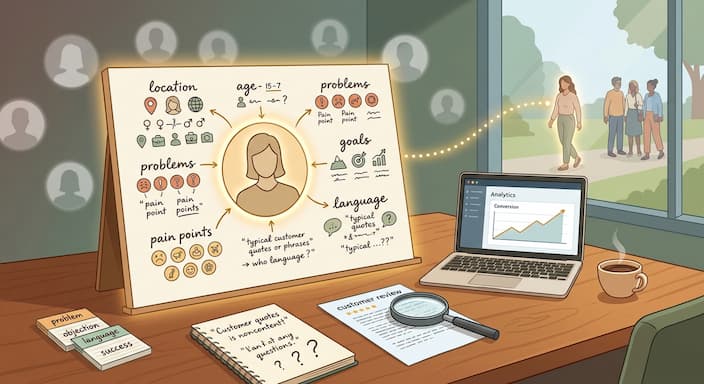
The ideal customer profile goes beyond age, gender, and location. It includes psychographics: what they believe, what they fear, what they hope for, what they’ve tried before, and why it didn’t work. It includes their language: the words they use to describe their problem, the phrases that make them feel understood, the jargon they identify with.
When you know your ideal customer this deeply, marketing stops feeling like guessing and starts feeling like having a conversation with someone you know well.
The Seven Questions That Reveal Your Ideal Customer
Here’s a practical process for building a profile that’s actually useful.
Question 1: Who Are Your Best Existing Customers?
Start with data, not imagination. Look at your current customer base and identify the top 20 percent—the ones who spend the most, stay the longest, refer the most, and complain the least.
For each of these customers, answer:
-
What do they have in common demographically?
-
What problem were they trying to solve when they found you?
-
What alternatives did they consider before choosing you?
-
What almost stopped them from buying?
-
What do they say about you to others?
Patterns will emerge. Those patterns are the raw material of your ideal customer profile.
Question 2: What Problem Are They Actually Trying to Solve?
This is the most important question, and the one most businesses get wrong. People don’t buy products. They buy solutions to problems.
But here’s the twist: the problem they tell you about is often not the real problem. A person buying a productivity app isn’t just trying to “get more done.” They’re trying to feel less overwhelmed. They’re trying to prove to themselves that they can handle their responsibilities. They’re trying to stop lying awake at night worrying about what they forgot.
The functional problem is the surface. The emotional problem is the driver. Your marketing needs to address both.
Question 3: What Have They Already Tried?
Understanding what your ideal customer has tried before—and why it didn’t work—is marketing gold.
If they’ve tried three other solutions and all failed, you need to explain why yours is different. If they’ve never tried anything, you need to explain why the problem is worth solving now. If they’ve tried something similar but it was too complicated or too expensive, address those specific barriers.
This question also reveals your real competition. It’s not always other businesses. Often it’s inertia, spreadsheets, doing nothing, or a workaround that’s “good enough.”
Question 4: What Are Their Objections?
Every purchase decision involves overcoming resistance. Understanding your ideal customer’s specific objections lets you address them proactively.
Common objections include:
-
Price (“It’s too expensive”)
-
Trust (“I’ve been burned before”)
-
Timing (“Now isn’t the right time”)
-
Complexity (“This looks too hard to use”)
-
Fit (“This isn’t for people like me”)
For each objection, ask: What would need to be true for this objection to disappear? What proof, guarantee, or explanation would overcome it?
Question 5: Where Do They Spend Their Time?
Once you know your ideal customer, you need to know where to find them.
Where do they read, watch, listen, and scroll? What podcasts do they subscribe to? What newsletters land in their inbox? What social platforms do they actually use (not just have accounts on)? What communities, forums, or groups do they participate in?
This determines your channel strategy. There’s no point in building a presence on a platform your ideal customer never visits.
Question 6: What Language Do They Use?
Use the words your ideal customer uses to describe their problem in your marketing.
If they say “I’m drowning in admin,” don’t write “optimize your workflow efficiency.” If they say “I can’t get my team on the same page,” don’t write “improve cross-functional alignment.”
Collect their exact phrases. Read reviews, testimonials, support tickets, and social media comments. Note the phrases that repeat. Use those phrases in your headlines, your ads, and your content. When you mirror their language, they feel understood.
Question 7: What Does Success Look Like for Them?
This isn’t about your product’s features. It’s about the outcome your customer is seeking.
What does their life look like when the problem is solved? What do they get to stop doing? What do they get to start doing? How do they feel?
This is the transformation you’re selling. Not the product. Not the features. The after state.
The Ideal Customer Avatar (Done Right)
Many marketing guides suggest creating a detailed avatar: a fictional person with a name, photo, job title, and backstory. This can be useful, but it can also become an exercise in creative writing that never informs actual decisions.
A better approach: create a profile that’s specific enough to guide decisions but flexible enough to evolve as you learn.
Demographics: Age range, location, income level, job title, family situation.
Psychographics: Values, beliefs, fears, aspirations, identity.
Problems: The functional problem they’re trying to solve and the emotional problem underneath it.
Alternatives: What they’ve tried before and why it didn’t work.
Objections: The specific reasons they hesitate to buy.
Channels: Where they consume information and who they trust.
Language: The words and phrases they use to describe their situation.
Success: What their life looks like when the problem is solved.
Keep this profile somewhere accessible. Review it before writing any marketing content. Ask: “Does this speak to this person?”
How to Attract More People Like Them
Once you know your ideal customer, the work shifts from definition to attraction. Here’s how to draw more people who match your profile.
Speak Directly to Them
Generic marketing attracts generic attention. Specific marketing attracts specific people.
Write headlines that name the problem your ideal customer has. Use the language they use. Describe their situation so accurately that they feel seen. When someone reads your content and thinks, “This is exactly what I’m dealing with,” you’ve done the attraction work.
Be Where They Already Are
Meet your ideal customer where they already spend time. If they’re on LinkedIn, build a LinkedIn presence. If they listen to podcasts, be a podcast guest. If they attend industry conferences, show up.
Many businesses try to drag customers to unfamiliar platforms instead of going where the customers already are. The path of least resistance is always the one that meets people where they are.
Create Content That Solves Their Specific Problems
Content marketing works best when it’s hyper-relevant to a specific audience. A blog post titled “How to Reduce Overwhelm for Freelance Designers” will attract freelance designers who feel overwhelmed. A post titled “How to Be More Productive” will attract… nobody in particular.
The more specific your content, the more it resonates with the people you want to reach. Specificity is not exclusion—it’s precision.
Use Social Proof from People Like Them
People trust recommendations from people who are like them. If your ideal customer is a small business owner, testimonials from other small business owners carry more weight than testimonials from enterprise executives.
Collect and showcase social proof that mirrors your ideal customer. Use case studies, testimonials, and reviews from people who fit the profile. When prospects see people like themselves succeeding with your product, they believe they can too.
Make the First Step Easy
Attracting the right people is only half the battle. Converting them requires an easy first step.
A free resource. A low-risk trial. A consultation. A newsletter. Something that lets them experience your value without a significant commitment. The goal is to reduce friction so genuinely interested people can raise their hands.
Build a Referral Engine
Your ideal customers know other ideal customers. They run in similar circles, share similar problems, and trust each other’s recommendations.
Make it easy for them to refer. Ask for referrals at the right moment—after they’ve experienced a win. Offer something in return, not as a bribe but as a thank-you. And make the referral process frictionless.
Repel the Wrong Customers
This is counterintuitive but essential. Attracting the right customers sometimes means actively filtering out the wrong ones.
Clear messaging that states who your product is not for is just as important as stating who it is for. “This isn’t for people who want a quick fix” or “This is designed for businesses with at least five employees” saves everyone time and prevents mismatched expectations.
When you’re clear about who you serve, the right people feel more confident that they’ve found the right place.
Common Mistakes to Avoid
Defining too broadly. “Anyone who wants to improve their health” is not an ideal customer. It’s a wish.
Defining too narrow. “Female vegan ultramarathoners aged 28-34 in Portland” might be too specific to build a sustainable business. The goal is a niche large enough to sustain you and specific enough to be meaningful.
Ignoring existing customers. Your best source of insight is people who have already bought from you. Talk to them. Survey them. Learn from them.
Confusing your ideal customer with yourself. Your preferences aren’t universal. The customer who needs what you sell may have different priorities, language, and behaviors than you do.
Never revisit the profile. Your ideal customer will evolve as your business grows and the market shifts. Review and refine the profile regularly.
Final Thoughts
That mentor’s question changed my business. “Describe your best customer—not the one you wish you had, but the one who actually buys, stays, and tells their friends.”
The answer was specific. It was a person, not a category. It was someone with a particular problem, a particular history, a particular way of talking about their situation. Once I knew who that person was, my marketing stopped being a guessing game and started being a conversation.
You don’t need to reach everyone. You need to reach the right people. The ones who will buy, stay, and refer—the ones who will become not just customers but advocates.
Find them. Speak to them. Serve them well. The rest will follow.