The cost of digital advertising is climbing every single year. You pour money into platforms like Facebook, Google, and TikTok, watching your customer acquisition cost creep higher while your profit margins shrink. It feels like you are renting your audience, and the landlord just raised the rent again. For many businesses, the default answer to “How do we make more money?” is simply “Spend more on ads.”
But the most lucrative, sustainable sales strategies in your business don’t require feeding the advertising machine. You already have untapped goldmines sitting inside your current operations, your customer list, and your website.
Instead of constantly chasing new eyeballs, you can dramatically increase your revenue by optimizing the assets you already own. Here is a comprehensive guide to boosting your sales without spending another dime on advertising.
1. Fix the Leaks in Your Bucket: Conversion Rate Optimization (CRO)
Imagine you are carrying a bucket of water from a well to your house. If the bucket has holes in it, you have two choices: you can either run back and forth faster (spending more money on ads to get more traffic), or you can plug the holes (Conversion Rate Optimization).
Most businesses have incredibly leaky websites. You might be getting 10,000 visitors a month, but if your website is confusing, slow, or untrustworthy, they are bouncing right off. If your current conversion rate is 1%, and you can increase it to just 2%, you have instantly doubled your sales without paying for a single extra visitor.
To plug the holes, start by looking at your checkout or lead capture process. Is it too long? Every extra form field you ask a customer to fill out drops your conversion rate. If you only need their email and first name, do not ask for their physical address and phone number.
Next, look at your site speed. If your website takes more than three seconds to load, over half of your visitors will abandon it before seeing your offer. Compress your images, upgrade your hosting, and clean up your code.
Finally, build immediate trust. Your homepage should instantly communicate exactly what you do and who you do it for. Add customer testimonials, logos of companies you’ve worked with, or trust badges (like money-back guarantees or secure checkout icons) near your “Buy” buttons. Make it psychologically safe and physically easy for people to hand you their money.
2. Master the “McDonald’s Strategy”: Increase Average Order Value (AOV)
If you can’t get more customers through the door, the easiest way to increase revenue is to get the customers who are already in the door to spend more money. This is the concept of Average Order Value (AOV).
The most famous example of this is the fast-food industry. “Would you like fries with that?” is an AOV strategy. They already paid to get you to the drive-thru; now they are maximizing the transaction.
You can implement this in your business today using a few specific tactics:
-
Order Bumps: Right before a customer clicks “Complete Purchase,” offer a small, highly relevant add-on. If they are buying a flashlight, offer a pack of batteries for $5. If they are buying a digital course, offer the audio-only version for an extra $15. Because they already have their wallet out, the friction to say “yes” to a small addition is incredibly low.
-
Product Bundling: Instead of selling items individually, group them together at a slight discount. If you sell skincare, bundle a cleanser, toner, and moisturizer into a “Morning Routine Kit.” The customer feels like they are getting a deal, and you move more inventory per transaction.
-
Free Shipping Thresholds: If your average order value is currently $40, offer free shipping on all orders over $60. Consumers hate paying for shipping and will routinely add a $20 item to their cart just to avoid a $7 shipping fee.
-
Post-Purchase Upsells: The moment immediately after someone buys is when they are most excited about your brand. Use a post-purchase upsell page that says, “Thank you for your order! While we prepare it for shipping, would you like to add [Premium Item] to your box at a 20% discount?”
3. Wake Up Your Dormant Buyers: Reactivation Campaigns
The probability of selling to a brand new prospect is roughly 5% to 20%. The probability of selling to an existing customer is 60% to 70%. Yet, business owners routinely ignore their past buyers to chase strangers on the internet.
The cheapest customer to acquire is the one you already have. They already know you, trust you, and have proven they are willing to spend money on your solutions.
If you have a list of past customers who haven’t bought anything in the last six months, it is time to run a Reactivation Campaign. Export this list from your database and send them a highly personalized, text-only email.
“Hi [Name], we haven’t seen you around in a while! I just wanted to check in and see how things are going. We just released [New Product/Service], and because you’ve shopped with us before, I’d love to give you a private 25% discount to try it out. Let me know if you want the link!”
Keep it conversational. Do not use a fancy, over-designed email template that looks like a corporate newsletter. Make it look like a personal message from the founder. You will be shocked by how many people reply, thank you for checking in, and take you up on the offer.
4. Turn Happy Clients into a Sales Team: Launch a Referral Program
People trust their friends more than they will ever trust your marketing copy. A glowing recommendation from a peer bypasses all the usual skepticism a buyer has when looking at a new business.
However, you cannot just sit back and hope your customers talk about you. You have to actively incentivize them to do it. You need a structured referral program.
The most successful referral programs are “double-sided.” This means both the person giving the referral and the person receiving the referral get a reward.
Think about how rideshare apps grew so quickly. “Give a friend $15 off their first ride, and you’ll get $15 off your next ride.” It creates a win-win scenario where the person sharing your business feels like a hero for giving their friend a discount, and they get rewarded for doing it.
You don’t need complicated software to start this. If you run a service-based business, simply email your best clients and say, “We are taking on three new clients this month. If you introduce us to someone who signs a contract, we will waive your retainer fee for next month, and give them 10% off their first project.”
Make it irresistible, make it easy to share, and actively remind your customers that the program exists.
5. Rescue Lost Money: Aggressive Abandoned Cart Sequences
If you run an e-commerce store, nearly 70% of people who put an item in their cart will leave your website without paying. That is a staggering amount of money left on the table. They were interested enough to browse, select an item, and start the checkout process, but then life got in the way. A dog barked, a text message came in, or they just decided to think about it later.
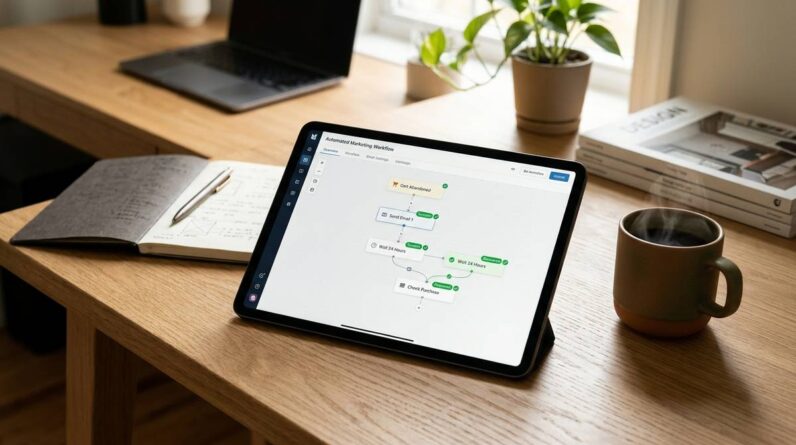
If you are only sending one generic “You left this in your cart” email, you are severely underperforming. You need a robust, automated sequence to recover these sales.
-
Email 1 (1 hour later): The gentle reminder. “Oops, looks like you left something behind! Here is a link to jump right back to your cart.” Keep it helpful, assuming a technical glitch or a distraction caused them to leave.
-
Email 2 (24 hours later): The social proof push. Don’t offer a discount yet. Instead, remind them why the product is great. Include a raving five-star review from a customer who bought the exact item they left in their cart.
-
Email 3 (48 hours later): The urgency and incentive. “Your cart is about to expire, and these are selling out fast. Take 10% off if you complete your order in the next 12 hours using this code.”
Implementing a tight three-part sequence like this can recover anywhere from 10% to 15% of your abandoned carts. That is pure, bottom-line revenue generated without ad spend.
6. Collaborate with Non-Competitors: Strategic B2B Partnerships
You have an audience, and other businesses have an audience. If your audiences overlap, but your products do not compete, you have the perfect recipe for a strategic partnership.
Let’s say you sell high-end organic dog food. Your ideal customers are affluent pet owners who care deeply about their animals’ health. Who else has that exact same audience? Local dog trainers, premium pet groomers, and boutique pet photographers.
Instead of paying Google to find these people, reach out to the dog trainer. Propose a cross-promotion. You will email your customer list about their amazing training services and offer a special discount code. In exchange, they will email their client list about your organic dog food with a special discount code.
You are essentially trading audiences. Because the recommendation comes from a trusted vendor they already do business with, the conversion rates on these partnerships are incredibly high. It costs you nothing but an email blast, yet it can bring in dozens of highly qualified new customers.
7. Stop the Bleeding: Focus Obsessively on Retention
Every time a customer leaves you for a competitor, you have to spend time, energy, and money to replace them just to keep your revenue flat. If you want to increase sales, you have to stop the bleeding. Retention is the new acquisition.
Customer churn is a silent killer in business. If you run a subscription service, an agency, or a coaching program, keeping a client for 12 months instead of 6 months instantly doubles the lifetime value of that customer.
To improve retention, you have to map out the “post-purchase journey.” What happens after they hand you their money? Do they hear crickets, or are they welcomed with open arms?
-
Onboarding: Create a spectacular onboarding experience. Send a personalized welcome video. Mail a handwritten thank-you note. Make sure they know exactly how to use your product or service to get the fastest result possible.
-
Proactive Support: Don’t wait for them to complain. Reach out at the 30-day mark just to ask, “Is there anything frustrating you about our service? How can we make this better?”
-
Surprise and Delight: Send unexpected bonuses. If they hit a milestone using your software, send them a branded coffee mug.
When your customers feel seen, appreciated, and successful, they don’t just stay longer—they become your loudest advocates.
8. Squeeze the Juice out of Your Content: Repurposing Strategy
Many businesses create a great piece of content—a blog post, a podcast episode, a comprehensive video—publish it once, and then immediately move on to creating the next thing. This is a massive waste of resources.
If you want more organic traffic without paying for ads, you need to learn how to repurpose your existing assets.
Take a single, high-performing blog post you wrote a year ago. That one article can be broken down and transformed into:
-
Five text-based posts for LinkedIn.
-
A Twitter/X thread summarizing the key points.
-
A script for a short-form YouTube Shorts or TikTok video.
-
An infographic for Pinterest.
-
A dedicated email newsletter for your subscribers.
You don’t need to constantly reinvent the wheel. Your audience isn’t seeing every single thing you post anyway. By repackaging your best ideas into different formats, you can distribute them across multiple platforms, driving organic traffic back to your website for months or even years from a single piece of foundational content.
9. The Ultimate Margin Booster: Raise Your Prices
This is the strategy that makes business owners the most nervous, but it is mathematically the fastest way to increase revenue without increasing overhead or advertising costs.
When was the last time you raised your prices? If it has been more than a year, you are likely undercharging, especially factoring in inflation and the experience you’ve gained over the last 12 months.
Raising your prices by just 10% drops pure profit straight to your bottom line. Yes, you might lose a small fraction of price-sensitive customers, but the increased margin on the customers who stay will more than make up for it.
If you are terrified of raising prices on existing customers, implement a “grandfather” clause. Tell your current clients, “Because you’ve been so loyal, you are locked in at your current rate for the next 12 months. However, all new clients starting next week will be paying the new rate.” This builds massive goodwill with your current roster while instantly increasing the value of every new deal you close.
Growing a business does not have to mean continuously feeding an expensive advertising machine. By focusing on the assets you already possess—your current traffic, your past buyers, your existing content, and your pricing structure—you can build a highly profitable, resilient business. Start by picking just one of the strategies above. Plug the leaks in your bucket, optimize your current flow, and watch your revenue grow predictably, sustainably, and profitably.