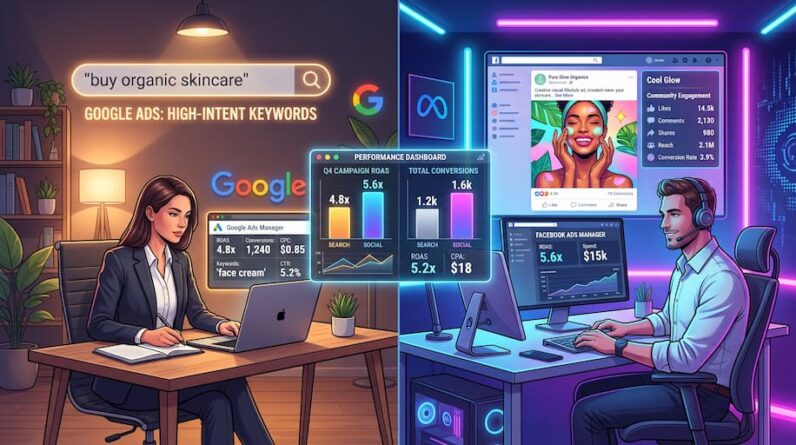
The Expensive Illusion of Paid Traffic
There is a dangerous, seductive belief that circulates widely among business founders and novice marketers: if you want more revenue, all you need to do is spend more money on paid advertising.
Enticed by promises of instant customer acquisition, business owners log into Meta Ads Manager, Google Ads, or LinkedIn Campaign Manager. They enter their credit card details, set a daily budget of one hundred dollars, upload a generic graphic, write three enthusiastic sentences about their product, and click publish.
Two weeks pass. The advertising platforms happily deduct fourteen hundred dollars from their corporate bank account.
The analytics dashboard reports thousands of impressions and several hundred clicks. But when the founder checks their payment processor or CRM inbox, they discover an agonizing reality: zero new customers, zero qualified sales calls, and an inbox filled with spam inquiries.
Frustrated, bewildered, and burnt by the experience, the business owner throws their hands up in defeat and declares: ‘Paid advertising simply does not work for my industry.’
That conclusion is completely false. Paid advertising is the most powerful, predictable customer acquisition engine ever invented in commercial history. When executed correctly, paid media allows you to input one dollar into an advertising system and extract three, four, or five dollars in profit like clockwork.
However, paid advertising is an unforgiving financial amplifier. It does not fix underlying marketing flaws; it magnifies them. If your offer is weak, your targeting is sloppy, or your tracking is broken, pouring money into ads is like trying to fill a swimming pool with a garden hose while ignoring five open drainage valves at the bottom.
In this comprehensive diagnostic guide, we will unpack the eleven most common, catastrophic advertising mistakes that quietly bleed your marketing budget dry, examine the mechanical reasons why they fail, and provide actionable protocols to transform your paid campaigns into profitable growth engines.
Mistake 1: Advertising to an Unvalidated Offer
The single most expensive mistake in commercial advertising is attempting to use paid media to discover whether people actually want your product.
Paid advertising is an accelerator for proven value propositions; it is not a laboratory for unvalidated concepts. If you cannot sell your product or service organically to five real human beings through direct conversations, personal networking, or cold outreach, you have zero business spending a single dollar on paid clicks.
When an offer fails to convert organically, the issue is almost always fundamental: your pricing is misaligned, your value proposition is confusing, or the market simply does not care about the problem you are solving.
Fixing It: Achieve organic proof of concept first. Verify that real customers are willing to part with hard-earned money for your offer. Only once your conversion mechanism is validated should you introduce paid media to scale your volume.
Mistake 2: The ‘Everyone Is My Customer’ Targeting Trap
When novice advertisers configure audience targeting settings, their instinct is to create massive, sprawling audience parameters. They think: ‘My software helps productivity, and everyone wants to be productive, so I will target all adults between twenty-five and sixty-five!’
When you attempt to speak to everyone, you end up speaking to nobody. Broad, generic messaging lacks emotional resonance and forces you to bid against massive multinational corporations with hundred-million-dollar budgets.
Fixing It: Target with laser precision. Narrow your audience down to an unmistakable, specific demographic or firmographic cohort. Write ad copy that addresses the unique, granular pain points of that exact group. Specificity dramatically lowers cost per lead while repelling unqualified browsers.
Mistake 3: The Broken Message-to-Landing-Page Match
Imagine clicking an advertisement that promises: ‘Download our 2026 B2B SaaS Churn Reduction Benchmark Report.’ You click with high enthusiasm, but when the page loads, you land on the company’s generic homepage showing executive headshots, mission statements, and a button that says ‘Request a Sales Demo.’
You feel disoriented and tricked. You immediately click the back button.
This jarring disconnect is known as a Message Match Failure. Over sixty percent of paid ad traffic is wasted because advertisers dump traffic onto generic homepages rather than dedicated, custom-tailored landing pages.
Fixing It: Ensure absolute visual, verbal, and conceptual symmetry between your ad creative and your destination page. The headline on your landing page should mirror the exact hook in your ad, and the page should focus exclusively on delivering the single promise that triggered the click.
Mistake 4: Treating All Platforms as Inter-Changeable
A winning advertisement on LinkedIn will fail miserably on TikTok, and an ad that goes viral on Instagram will fall flat on Google Search.
Each platform operates under fundamentally distinct user psychologies:
- Google Search is Intent-Driven: Users are actively looking for an immediate solution to a specific problem. They want direct answers, clear pricing, and fast implementation.
- Meta (Facebook and Instagram) is Interruption-Driven: Users are relaxing, catching up with friends, and looking for entertainment. Your ad must arrest their visual attention and spark spontaneous emotional curiosity.
- LinkedIn is Status-Driven: Users are thinking about their professional reputations, career advancement, and corporate risk mitigation.
Fixing It: Tailor your creative format and copywriting tone specifically to the psychological environment of each respective channel. Respect the medium, and your conversion rates will climb.
Mistake 5: The Premature Optimization Syndrome (Touching Dials Too Early)
In the modern advertising landscape, paid media algorithms (Meta Lattice, Google Smart Bidding) rely on deep machine learning to identify optimal buyers.
When you launch a new campaign, the system enters an essential algorithmic exploration window known as the Learning Phase. During these initial five to seven days, performance metrics fluctuate wildly as the algorithm tests different user clusters.
Amateur media buyers panic after twenty-four hours. They see a high cost per click on day two, panic, pause the ad, change the headline, adjust the budget, and swap the image.
By constantly tinkering with settings, they reset the algorithm learning curve back to zero every single day, keeping the campaign trapped in permanent, expensive inefficiency.
Fixing It: Establish emotional discipline. Calculate your target sample size and allow campaigns to spend their baseline budget uninterrupted for at least five to seven days before making qualitative optimizations. Let the machine learning do its job.
Mistake 6: Optimizing for Vanity Metrics Over Business Revenue
It is easy to construct an advertisement that generates ten thousand cheap video views or thousands of clicks for pennies. All you have to do is use sensational clickbait, provocative imagery, or controversial memes.
Marketing teams often present these vanity numbers to executive boards with triumphant smiles: ‘Look at our engagement rate!’
Yet when finance audits revenue, those clicks generated zero pipeline value. Clicks that do not convert into qualified leads or paying customers are simply overhead expenses.
Fixing It: Optimize campaigns exclusively for deep bottom-of-funnel conversion events: booked discovery calls, qualified lead submissions, and completed checkout transactions. Train your advertising pixels on buyers, not casual scrollers.
Mistake 7: Ignoring Creative Ad Fatigue and Creative Stagnation
Even the most brilliant, high-converting advertisement will eventually stop working.
As your target audience sees the exact same image and headline ten, fifteen, or twenty times over several weeks, a phenomenon known as Ad Fatigue sets in. Click-through rates plunge, auction costs spike, and customer acquisition costs spiral upward.
Novice advertisers leave their original winning ad running for six months, wondering why their profit margins gradually evaporated.
Fixing It: Implement an ongoing Creative Testing Pipeline. Allocate fifteen to twenty percent of your weekly budget specifically to test fresh hooks, visual formats, and angles. When your primary winning ad begins to fatigue, you already have a proven successor ready to step into its place.
Mistake 8: Neglecting Mobile User Experience and Page Speed
Over seventy percent of social media ad clicks occur on mobile devices. Yet many businesses design and test their landing pages exclusively on high-speed desktop office computers with fiber-optic internet.
When a mobile user clicks your ad while riding a bus on cellular data, your page takes seven seconds to load because it is bogged down by uncompressed four-megabyte images and bloated javascript tracking tags.
Google research proves that fifty-three percent of mobile visitors abandon a website if it takes longer than three seconds to load. You are paying for clicks that never even see your headline.
Fixing It: Audit your landing page using mobile performance benchmarks. Compress images under one hundred kilobytes, eliminate unnecessary scripts, and ensure all buttons are thumb-friendly and effortlessly readable on small screens.
Mistake 9: The One-Night Stand Fallacy (Zero Retargeting Infrastructure)
Ninety-seven percent of first-time visitors will not buy from you on their initial visit. They do not know you, they do not fully trust you, and their life is full of daily distractions.
If your advertising strategy consists solely of driving cold traffic and hoping visitors buy immediately, you are abandoning ninety-seven percent of your potential revenue on the table.
Fixing It: Build a multi-tiered retargeting system. Serve warm, sequential follow-up ads to previous site visitors: showcasing customer case studies, addressing common objections, and offering risk-reversal guarantees over a thirty-day window.
Mistake 10: Broken Conversion Tracking and Attribution Blindness
You cannot fix what you cannot measure. A staggering percentage of small business ad accounts operate with improperly installed conversion tags, duplicate pixel events, or broken server-side API connections.
When your tracking architecture is broken, your advertising dashboard reports false data, and the algorithm cannot optimize for your highest-value customers.
Fixing It: Verify your tracking setup using official developer diagnostic extensions. Ensure server-side Conversion APIs are active to bypass ad-blockers and maintain crystal-clear visibility into your true return on ad spend.
Mistake 11: The Absence of Irresistible Risk Reversal
At the final moment of decision, prospective buyers experience acute financial loss aversion. They wonder: ‘What if this product does not work for me? What if I look foolish?’
If your ad copy fails to address that fear, the prospect defaults to safety: doing nothing.
Fixing It: Remove all perceived friction by introducing clear, bold risk reversal. Offer generous thirty-day money-back guarantees, free trials, or milestone-based performance assurances. When you remove the risk of saying yes, conversions surge.
Conclusion: Turning Your Ad Spend into an Investment
Advertising is not an expense to be minimized; it is an investment mechanism to be perfected.
When you eliminate these eleven budget leaks, you stop burning cash and begin building a resilient, mathematical customer acquisition engine that fuels long-term business growth.
Audit your active campaigns today against this eleven-point checklist. Plug your leaks, respect your data, and watch your advertising profitability soar.