The Hidden Leak in Your Sales Funnel
Picture this classic online shopping scenario: You spend hours dialing in your social media advertising, perfecting your product photography, negotiating supplier costs, and tweaking your checkout flow. A curious browser clicks your ad, lands on your product page, glances at the photo, scrolls down to read the details, pauses for four seconds… and clicks the “Back” button, gone forever.
What just happened?
Nine times out of ten, that lost sale wasn’t caused by your shipping rates or your website’s color palette. It was killed by a bland, lifeless, cut-and-paste manufacturer description that read like an instruction manual written by a tired robot.
Far too many ecommerce founders treat product descriptions like a chore—a boring little box that simply lists dimensions, materials, and care instructions. But in modern commerce, where consumers have endless choices and micro-second attention spans, your product description is not an inventory receipt. It is your 24/7 digital salesperson.
When someone picks up an item in a physical boutique, they can touch the supple leather, smell the cedarwood, test the weight of the ceramic mug, and ask the store associate questions. Online, that physical sensory feedback is gone. Your copy is the only bridge between the customer’s skepticism and their credit card.
In this instructional guide, we are going to walk through the exact psychology, structural frameworks, and copywriting secrets that transform dry technical specs into magnetic, irresistible sales copy that turns passive browsers into proud paying customers.
The Fatal Mistake: Selling What It Is Instead of What It Does
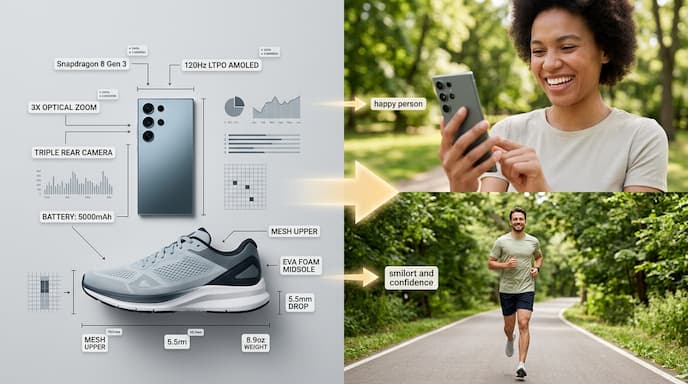
If you take only one lesson from this entire article, let it be this fundamental copywriting rule: Features tell, but benefits sell—and transformations close.
Let us dissect the anatomy of these three layers:
- The Feature (What it is): A factual specification, technical parameter, or physical component of your product.
- Example: “This insulated tumbler is manufactured with 18/8 double-walled vacuum stainless steel.”
- The Benefit (What it does): What the feature actually accomplishes for the user’s daily life.
- Example: “It keeps your cold brew iced for up to 24 hours, even if you leave it in a sweltering car.”
- The Transformation (Who they become): The emotional payoff, relief, or identity shift experienced by the buyer.
- Example: “Never suffer through lukewarm, watered-down coffee during your morning commute again—enjoy coffeehouse-fresh perfection on your terms, all day long.”
When amateur copywriters sit down to write, they fill bullet points with raw features: “100% organic cotton, 280 GSM weight, reinforced double-stitching.” To an engineer, that sounds precise. To an everyday shopper scrolling on their phone while making dinner, it is utterly meaningless.
To bridge this gap, professional copywriters use the “So What?” Test.
The “So What?” Test in Action
Every time you write down a product feature, pretend a skeptical customer is sitting across from you crossing their arms and asking: “So what? Why should I care?”
- Feature: Our hiking boots feature a waterproof Gore-Tex membrane.
- So what?
- Benefit: Water cannot seep inside when you step into deep puddles or muddy streams.
- So what?
- Transformation: You can hike twelve miles in pouring rain without having to peel off soaked, blistered socks at the end of the trail.
Notice how the conversation moved from chemical membranes to blister-free comfort. That emotional relief is what people actually buy.
The Psychology of the Online Buyer: Friction and Desire
Every time a consumer evaluates a product page, their subconscious mind is running a delicate mental tug-of-war between two forces: Desire (the excitement of possessing the item) and Friction (the fear of regret, wasting money, or dealing with hassle).
Your product description has two simultaneous jobs:
- Turn up the volume on Desire by helping the reader vividly visualize ownership.
- Systematically eliminate Friction by tackling objections before they surface.
Overcoming the Four Pillars of Buyer Hesitation
Whenever a customer hesitates at the “Add to Cart” button, one of four unspoken doubts is flashing in their brain:
- Will this fit or work for me specifically?
- The Solution: Provide tangible sizing context, compatibility details, and real-world usage scenarios. Don’t just say “fits true to size”; say “our model Sarah is 5’7″ wearing a Medium; if you prefer an oversized layering fit, size up.”
- Is it worth the money compared to cheaper alternatives?
- The Solution: Justify the price tag by pulling back the curtain on craftsmanship, durability, or cost-per-use economics. A $90 chef’s knife sounds expensive until you explain that it replaces five cheap serrated blades that dull after six months.
- What happens if I dislike it or make a mistake?
- The Solution: Embed risk reversal directly next to your call to action. Mention your 30-day hassle-free trial, prepaid return labels, and responsive human customer support.
- Can I trust this company?
- The Solution: Weave micro-social proof into your copy: “Over 14,000 home chefs rely on this skillet every morning,” or quote a snippet from a verified review directly within the description body.
The 5-Part High-Converting Description Anatomy
You do not need to stare at a blank page wondering where to begin. Most top-performing DTC brands follow a proven structural blueprint that guides the reader seamlessly from curiosity to conversion:
Section 1: The Magnetic Hook
Start with a compelling bold one-liner or punchy opening hook. Avoid generic statements like “Introducing our new backpack.” Instead, speak directly to the core desire:
- “The last carry-on duffel you will ever pack for a weekend getaway.”
- “Finally: A natural deodorant that survives humid summer afternoons and intense gym sessions.”
Section 2: The Sensory Narrative
In 3 to 5 sentences, paint a vivid picture of the product in action. Engage sensory language—sight, sound, touch, and smell. Help the reader “mentally test-drive” the item before buying it. If you sell artisan roasted coffee beans, describe the rich aroma of dark cocoa and toasted hazelnut that fills the kitchen as the kettle whistles, rather than merely stating “Medium roast Arabica blend.”
Section 3: The Scannable Benefit Bullets
Over 75% of ecommerce shoppers browse on mobile devices while skimming rapidly. If your product page is a dense wall of text, they will bounce. Structure your core benefits into 4 to 6 scannable bullet points using the Bold Benefit + Proof Formula:
- Stays Ice-Cold for 24 Hours: Double-wall copper vacuum insulation prevents temperature loss, even under direct desert sun.
- Zero Shoulder Strain: Contoured memory foam straps distribute heavy laptop weight evenly across your back.
- Wrinkle-Free Straight From the Suitcase: Engineered with 4-way stretch bamboo fabric that shakes out smooth without an iron.
Section 4: The Clean Specs Accordion
Analytical and detail-oriented shoppers will always look for hard numbers. Keep this data clean, organized, and separated from the main narrative using a specs table or dropdown accordion:
- Dimensions, volume, and empty weight
- Materials, fabrics, and country of origin
- Care instructions, washing guidelines, and warranty terms
Section 5: The Reassurance & Action Prompt
Close the loop by reiterating your promise. Remind them why buying right now is safe, exciting, and risk-free:
- “Backed by our 100-Day No-Questions-Asked Trial. Try it on your next trip; if it isn’t the best bag you’ve ever owned, we’ll buy it back.”
Master the Language: Power Words and Sensory Verbs
The specific vocabulary you choose dramatically impacts the perceived value of your product. Words are psychological triggers that evoke feelings of luxury, reliability, speed, or comfort.
Sensory Words That Bring Descriptions to Life
Instead of relying on tired, generic adjectives like “nice”, “great”, or “high quality”, use sensory descriptors that trigger subconscious associations:
- Touch & Texture: Buttery-soft, rugged, velvety, featherlight, crisp, substantial, silky, textured, seamless.
- Sound & Auditory: Whisper-quiet, satisfying click, muted snap, silent glide.
- Visual & Form: Minimalist, radiant, deep indigo, matte finish, sculpted, sleek, unobtrusive.
- Taste & Aroma: Zesty, rich amber, smoky undertones, decadent, invigorating citrus.
Words to Ruthlessly Cut From Your Descriptions
Certain corporate buzzwords have been so overused that consumers’ eyes slide right past them without registering any meaning. If you spot any of these in your drafts, eliminate or replace them with specific evidence:
- “World-class” (Says who? Show your awards or customer ratings instead.)
- “Cutting-edge” (What specific mechanism makes it innovative?)
- “Best-in-class” (Give the exact comparison or metric.)
- “Very unique” (Unique has no degrees; explain what distinct feature sets it apart.)
Real-World Makeover: Before & After Case Studies
To understand how these principles function in the real world, let us look at two before-and-after transformations across common ecommerce niches:
Case Study 1: Specialty Leather Backpack
The “Before” (Manufacturer Spec Sheet)
Men’s Leather Backpack
Genuine cowhide leather backpack with adjustable straps and brass buckles. Fits up to 15-inch laptops. Measures 16″ x 12″ x 5″. Features front zipper pocket and canvas lining. Suitable for work, school, and travel.
Why it fails: It reads like a customs declaration form. There is zero emotion, zero lifestyle aspiration, and zero reason to pay a premium price.
The “After” (High-Converting Copy)
The Weekender Leather Pack: Built to Outlast Your Longest Journeys
Most modern bags wear out after a few airport sprints. The Weekender gets better with every mile. Handcrafted from rugged full-grain vegetable-tanned leather, this pack develops a rich, personalized patina that tells the story of your travels.
Slip your 15-inch MacBook into the padded, fleece-lined protective sleeve, toss your passport and earbuds into the quick-access magnetic front pocket, and move through airport security without missing a step.
Why You’ll Love Traveling With It:
- Zero Digging at Check-In: Dedicated quick-grab passport and key pocket keeps travel essentials right at your fingertips.
- All-Day Commute Comfort: Padded ergonomic shoulder straps distribute heavy laptop weight so your back feels fresh at 5:00 PM.
- Stands Upright on Its Own: Reinforced flat base prevents your bag from tipping over on coffee shop floors.
- Weather-Resistant Security: Heavy-duty YKK antique brass zippers glide smoothly and keep sudden downpours away from your tech.
Backed by our Lifetime Craftsmanship Guarantee. If a seam fails or a rivet pops, we repair or replace it for free—forever.
Case Study 2: Natural Lavender Sleep Pillow Mist
The “Before” (Generic Health & Wellness)
Lavender Sleep Spray (4 oz)
Made with 100% natural French lavender essential oil and distilled water. Spray on pillows before bedtime to help you fall asleep. Non-toxic and cruelty-free.
Why it fails: It treats a major emotional pain point—chronic sleeplessness and daily stress—like a mundane household spray.
The “After” (High-Converting Copy)
The Restful Night Pillow Mist: Turn Your Bedroom Into a 5-Star Sanctuary
When your mind is racing after an exhausting ten-hour workday, counting sheep doesn’t cut it. Two gentle spritzes of our French Lavender Mist onto your pillowcase create an immediate sensory signal to your nervous system: the day is over; it’s safe to rest.
Distilled from wild-harvested High-Provence lavender and delicate Roman chamomile, this subtle botanical mist blankets your bed in calming aromatics without sticky residue or artificial chemical perfumes.
The Bedtime Difference:
- Fall Asleep 20 Minutes Faster: Clinically-studied lavender terpenes help slow your heart rate and ease racing evening thoughts.
- Zero Pillow Stains: 100% water-soluble botanical formula evaporates clean without leaving oil rings on your favorite silk or cotton sheets.
- Pure Peace of Mind: Completely free from synthetic fragrances, parabens, and aerosol propellants—safe for sensitive skin and curious pets.
Wake up feeling genuinely restored, or take advantage of our 30-Night Sweet Dreams Guarantee for a full refund.
Formatting for the Modern Mobile Skimmer
Even compelling copy will fail if it looks intimidating on a 6-inch smartphone screen. Keep these design and formatting rules in mind when uploading descriptions to your storefront:
- Keep Paragraphs Under 3 Sentences: Large blocks of text create visual fatigue. Use plenty of whitespace to make reading effortless.
- Bold the First 2–4 Words of Every Bullet: Skimmers read in an F-shaped pattern. By bolding the core benefit at the start of each bullet point, you ensure they absorb your key value propositions in under five seconds.
- Use Subheadings (H3s) as Mini-Billboards: If a customer only reads your headlines and bullet titles, they should still understand 80% of your product’s value.
- Strategically Place Icons & Badges: Pair key phrases like “Free Shipping”, “Eco-Friendly”, and “Lifetime Warranty” with clean minimalist icons near the Add-to-Cart button.
The Pre-Publishing Checklist: 7 Questions to Ask Before Going Live
Before you hit “Publish” on your next product description, run your copy through this quick quality audit:
- Did I banish generic buzzwords? Have I replaced vague adjectives like “high quality” with tangible, verifiable proof?
- Did I pass the “So What?” test? Does every feature connect to a clear, relatable human benefit?
- Is the copy skimmable on a mobile phone? Are there clean bullet points, short paragraphs, and bolded lead-ins?
- Did I paint a sensory picture? Can the reader imagine touching, tasting, smelling, or using the product?
- Are all technical questions answered? Did I include dimensions, sizing, materials, and compatibility specs?
- Is there strong risk reversal? Is the return policy, warranty, or guarantee prominently mentioned?
- Is there a single, clear next step? Does the copy inspire confidence to click “Add to Cart” right now?
Writing product descriptions that convert is not about literary genius; it is about empathy. When you genuinely understand your customer’s frustrations, celebrate their aspirations, and respect their time with scannable, benefit-driven prose, your product pages will transform from passive digital catalog entries into high-performing sales machines.