The Billion-Dollar Dilemma
If you have ever stared at a modest marketing budget and wondered whether to give your hard-earned dollars to Sundar Pichai or Mark Zuckerberg, you are definitely not alone. Every single entrepreneur, freelancer, and growing company eventually arrives at the exact same crossroads: Should you run Google Ads or Facebook Ads?
The short answer that every annoying marketing consultant loves to give is: “It depends.”
While that answer is technically true, it does not help you make a smart financial decision before Friday. What you actually need to know is what it depends on, how each platform operates beneath the hood, how much each click is going to cost you, and where your specific target customers are hanging out when their wallets are open.
Over the years, both platforms have evolved dramatically. Google Ads is no longer just simple blue search links; it encompasses Performance Max, YouTube video campaigns, Google Shopping, and local map ads. Meanwhile, Facebook Ads (officially Meta Ads) has expanded across Instagram, Messenger, WhatsApp, and the Meta Audience Network, driven by powerful artificial intelligence algorithms that can find lookalike audiences with uncanny accuracy.
Yet, despite their technical sophistication, Google and Facebook address fundamentally different types of human behavior. Understanding that single difference is the secret to never wasting a single marketing dollar again. In this comprehensive, step-by-step guide, we are going to break down the psychological differences, financial realities, targeting capabilities, and conversion pathways of both giants so you can confidently pick the right platform for your business.
The Core Psychological Divide: Demand Capture vs. Demand Generation
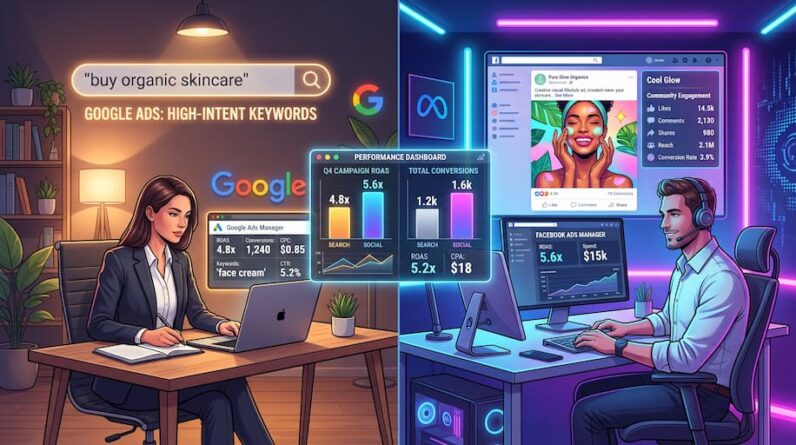
Before we talk about cost-per-click (CPC) or return on ad spend (ROAS), let us establish the golden rule of online advertising: Google captures active demand, while Facebook generates latent demand.
Think about how you personally use each platform.
When your basement pipes burst at 2:00 AM, you do not open Facebook, scroll through memes, and wait for an emergency plumber to show up in your feed. You open Google, type “emergency plumber near me open now”, and click the very first phone number that appears. That is Demand Capture. You already know you have a problem, you are actively seeking an immediate solution, and your intent to purchase is at an absolute peak.
On the other hand, consider how you discover a revolutionary ergonomic desk chair or a handcrafted leather wallet. You probably were not searching for it. Instead, on a lazy Sunday afternoon, you were scrolling through Instagram or Facebook checking up on your friends. Suddenly, a beautifully shot video ad appeared demonstrating how poor posture wrecks spinal health, showcasing an adjustable lumbar chair that looks incredible in a modern home office. You stop scrolling, click through, read a few reviews, and buy it. That is Demand Generation. You did not know you needed that product five minutes prior, but compelling visual storytelling created the desire from scratch.
When to Prioritize Demand Capture (Google Ads)
Google Ads is undefeated when your potential customer is already looking for what you offer:
- Emergency and immediate-need services: Locksmiths, roofers, tow trucks, criminal defense attorneys, and urgent care clinics.
- High-intent commercial queries: Software searches like “best CRM for real estate agents” or product searches like “buy titanium camping cookware”.
- Local service providers: Dentists, accountants, mechanics, and landscapers who rely on geographic search queries.
- Specific replacement parts or specialized items: If someone needs an exact model of a water pump impeller, they search for the SKU on Google.
When to Prioritize Demand Generation (Facebook Ads)
Facebook Ads is unmatched when you have a product or service that benefits from visual demonstration, lifestyle appeal, or impulse discovery:
- Visual consumer products (D2C Ecommerce): Fashion, jewelry, cosmetics, home decor, unique kitchen gadgets, and fitness apparel.
- Novel or innovative inventions: If you invented a new device that nobody knows exists yet, nobody is typing its name into Google. You must demonstrate it visually on social media feeds.
- Lifestyle and passion-driven offers: Outdoor gear, hobby clubs, music festivals, culinary experiences, and pet accessories.
- Low-friction lead magnets: Free ebooks, webinars, workshops, quizzes, and digital templates designed to capture email subscribers.
Understanding Google Ads: How It Works and What It Costs
Google processes over 8.5 billion searches every single day. When you advertise on Google, you are positioning your business directly along the digital highway where people are actively hunting for answers.
The Major Google Ads Networks
- The Search Network: The classic text-based ads that appear above and below organic search engine results pages (SERPs). These are triggered by specific keywords chosen by the advertiser.
- Google Shopping: Product listing ads that show a high-resolution photo, product title, price, merchant name, and customer ratings right at the top of search results. Essential for physical product retailers.
- The Display Network: Visual banner ads that appear across millions of partner websites, blogs, news portals, and mobile apps. Best for brand awareness and retargeting rather than direct cold acquisition.
- YouTube Ads: Video advertisements running before, during, or alongside YouTube videos. Great for combining visual demonstration with Google’s rich audience intent data.
- Performance Max (PMax): An automated campaign type that uses machine learning to distribute your assets across Search, Display, YouTube, Gmail, Maps, and Discover simultaneously.
The Pricing Model of Google Ads
Google operates on an auction-based Pay-Per-Click (PPC) model. You only pay when an interested user actually clicks on your advertisement.
However, your position on the page is not determined solely by who has the deepest pockets. Google utilizes a metric called the Ad Rank, calculated by multiplying your maximum bid by your Quality Score.
Quality Score is graded on a scale of 1 to 10 based on:
- Expected Click-Through Rate (CTR): How likely Google thinks someone will click your ad based on historical performance.
- Ad Relevance: How closely your ad text matches the user’s search query.
- Landing Page Experience: How fast, mobile-friendly, transparent, and relevant your landing page is to the visitor.
A high Quality Score acts as a massive discount code. A small business with a Quality Score of 9 can easily outrank an enterprise competitor with a Quality Score of 4 while paying significantly less per click.
Typical Costs on Google Ads
Across all industries, the average Cost-Per-Click on Google Search is between $2.00 and $5.00. However, this variance is extreme. If you sell children’s toys, you might pay $0.80 per click. If you are a personal injury attorney in Los Angeles bidding on “car accident lawyer”, you could easily pay upwards of $150.00 for a single click. The cost directly mirrors the commercial value of that lead.
Understanding Facebook (Meta) Ads: How It Works and What It Costs
Meta reaches more than 3 billion monthly active users across Facebook, Instagram, Messenger, and its connected networks. Unlike Google’s search box, which knows what people want right now, Meta’s algorithm knows who people are, what they care about, what they look at, and what life stages they are currently navigating.
The Power of Meta’s Algorithm and Ad Formats
Meta ads seamlessly blend into the organic user experience. Rather than looking like traditional classified banner ads, they appear as native feed posts, Stories, and full-screen vertical Reels.
Key formats include:
- Single Image & Video Ads: Standard feed placements optimized for engaging storytelling and quick hook rates.
- Carousel Ads: Up to 10 swipeable cards featuring different products, features, or sequential narrative steps.
- Reels Ads: 9:16 vertical video experiences designed to capture short-attention-span mobile viewers.
- Lead Generation Ads: In-app forms that auto-populate with the user’s profile information, allowing lead capture without forcing users to leave the platform.
Audience Targeting Capabilities
While privacy regulations and Apple’s App Tracking Transparency (ATT) framework altered third-party tracking, Meta’s on-platform behavioral signals remain extraordinarily powerful:
- Broad & Algorithmic Targeting (Advantage+): Meta’s AI analyzes your visual creative and copy to automatically hunt down the exact users most likely to convert, often outperforming manual interest-based targeting.
- Interest & Demographic Targeting: Targeting based on user hobbies, preferred media, job titles, relationship status, parent status, and purchasing behaviors.
- Custom Audiences: Uploading your own customer email lists, website visitor pixels, or engaged social media followers to target warm prospects.
- Lookalike Audiences: Instructing Meta to find the top 1% of users in a specific country who statistically mirror the characteristics of your best existing customers.
The Pricing Model of Facebook Ads
Unlike Google Search’s click-based billing, Facebook primarily bills on an impression basis: Cost-Per-Mille (CPM), which is the cost per 1,000 ad impressions.
Because you pay for impressions regardless of whether users click, your ad creative does the heavy lifting. If your creative is dull and only 0.5% of viewers click, your effective cost per lead will be high. If your creative is magnetic and stops thumbs, yielding a 3.5% click-through rate, your cost-per-click will plummet.
Typical Costs on Facebook Ads
On average, CPMs on Meta range from $10.00 to $25.00, resulting in average CPCs between $0.60 and $2.00 across most general consumer and B2B categories. This makes Facebook an exceptionally affordable arena for testing ideas, building an audience, and generating initial customer interest.
Head-to-Head Comparison: 5 Critical Factors
To make your decision as straightforward as possible, let us evaluate both platforms across five essential business dimensions:
1. Purchase Intent and Buyer Readiness
Google Search is the undisputed champion of buyer readiness. When someone types “buy organic dog food subscription free delivery”, they already have their credit card sitting on the desk. They do not need to be persuaded that dogs need food; they just need to know why your brand is the best choice.
On Facebook, purchase intent is low at first contact. You are interrupting someone who was watching a video of their niece’s birthday party. Therefore, your ad must hook their attention in under three seconds, educate them about a hidden problem, and deliver a frictionless reason to take action.
2. Creative and Asset Production Demands
Google Search ads are remarkably light on production requirements. You write compelling headlines, engaging descriptions, select sitelink extensions, and direct traffic to a dedicated landing page. You do not need professional graphic designers or video editors to launch a profitable Google Search campaign.
Facebook, however, is a hungry visual beast. Even your most profitable Facebook ad will suffer from “ad fatigue” within 2 to 6 weeks as your target audience sees it repeatedly. To sustain performance on Meta, you must continually produce fresh creative assets: short-form user-generated content (UGC), product unboxings, customer reaction videos, and clean carousel graphics.
3. Cost-Per-Lead vs. Lead Quality
Beginners often look at Facebook’s cheap lead costs and assume it is the superior platform. You might generate email leads on Facebook for $3.50, whereas Google Search might cost $18.00 per lead for the same service.
However, lead quality tells a different story. Because Google leads were actively searching for your service, their sales closing rate is frequently 3x to 5x higher than Facebook leads. A $20 lead that converts into a customer 25% of the time is vastly more profitable than a $4 lead that converts only 2% of the time. Always measure your return in revenue, not just vanity cost-per-click metrics.
4. Scalability and Audience Saturation
Google Search is constrained by search volume. If only 12,000 people per month search for “bespoke timber pergolas in Austin, Texas”, you cannot force 50,000 people to see your search ads. Once you capture 80% of the available search impression share for your keywords, you hit a ceiling.
Facebook’s scale is virtually limitless. Because you are generating demand rather than waiting for queries, you can reach hundreds of thousands or even millions of relevant prospects by refining your broad targeting and introducing new video angles. For rapid, high-volume consumer scaling, Facebook holds the upper hand.
5. Time-to-Results and Learning Curves
A properly structured Google Search ad targeting high-intent exact-match keywords can generate inquiries within hours of approval. The feedback loop is immediate: people searched, clicked, and called.
Facebook Ads relies heavily on machine learning optimization. The Meta Pixel requires approximately 50 conversion events per ad set within a 7-day window to exit the “Learning Phase” and stabilize delivery. This means Facebook often requires patience and an upfront testing budget while the algorithm calibrates who among the vast user base is your ideal buyer.
Step-by-Step Decision Framework: Which One Fits Your Business?
Still wondering which button to press first? Use this practical diagnostic framework to identify your ideal starting platform:
- Is there established search volume for your specific product or service?
- NO: Choose Facebook Ads. Your offer is novel, highly visual, or impulse-driven. Educate and captivate audiences with short-form video and lifestyle imagery.
- YES: Move to question 2.
- Are customers in urgent or immediate need? (e.g., emergency repairs, legal consultation, local trade services)
- YES: Choose Google Search Ads. Capture direct intent when the critical need arises.
- NO: Move to question 3.
- What is your average order value (AOV) and purchase cycle?
- Low AOV (<$50, Ecommerce/Lifestyle): Choose Facebook Ads. Visually appealing impulse purchases flourish on Meta.
- High AOV ($500+, B2B/High-Ticket Service): Choose Google Search first, then retarget on Facebook.
The Ultimate Hybrid Playbook: How the Best Marketers Combine Both
Here is the secret of top-performing digital marketers: They rarely choose only one. Instead, they build a collaborative marketing engine where Google and Facebook feed each other.
Here is the exact step-by-step blueprint to orchestrate both platforms into a cohesive funnel:
Phase 1: High-Intent Capture on Google Search
Allocate 60% of your starting budget to Google Search Ads targeting high-intent, bottom-of-funnel keywords. These are queries containing buying signals: “pricing”, “buy”, “hire”, “consultant”, “reviews”, or specific competitor alternatives. This establishes immediate cash flow by capturing customers who are ready to purchase today.
Phase 2: Behavioral Retargeting on Meta
Roughly 95% to 98% of the people who click your Google ad will browse your website and leave without purchasing. Do not let them slip away! Install the Meta Pixel and Conversions API on your website. Build a Custom Audience of visitors who visited your sales page in the last 14 days but did not reach the thank-you or order-confirmation page.
Phase 3: Social Proof and Objection Handling on Facebook
Run low-budget retargeting ads on Instagram and Facebook showing customer video testimonials, behind-the-scenes founder stories, answers to common objections, and limited-time bonus incentives. When these prospects are relaxing in the evening on social media, your brand reappears with credible social proof, gently guiding them back to finish their order.
Phase 4: Expansion and Lookalike Scaling
Once your Google Search and Meta retargeting funnels consistently generate customers at a profitable ROAS, take the customer list generated from Google sales and upload it to Meta. Create a 1% Lookalike Audience to discover thousands of lookalike consumers across Facebook and Instagram, unlocking a brand-new stream of top-of-funnel cold traffic.
Actionable Takeaways & Next Steps
- Check Your Search Volume First: Before spending a dime on Google, use Google Keyword Planner (free inside Google Ads) to verify that people are actively typing your service or product into the search bar with commercial intent.
- Audit Your Creative Pipeline: If you choose Facebook, ensure you have the capacity to film authentic video hooks, customer reactions, and product demonstrations. Video is no longer optional on Meta.
- Start Small, Master One, Then Branch Out: Never split a $500 monthly budget across four platforms. Pick the one platform that aligns most strictly with your business model, achieve a consistent customer acquisition cost (CAC), and only then reinvest your profits into the second platform.
- Focus on Unit Economics Over Platform Hype: A platform is merely an auction house. Your success ultimately hinges on the clarity of your unique selling proposition, the strength of your guarantee, and the conversion rate of your landing page.
By matching your marketing channels to your customer’s mindset—catching their intent on Google or sparking their curiosity on Facebook—you turn advertising from an unpredictable gamble into a reliable, repeatable engine for business growth.