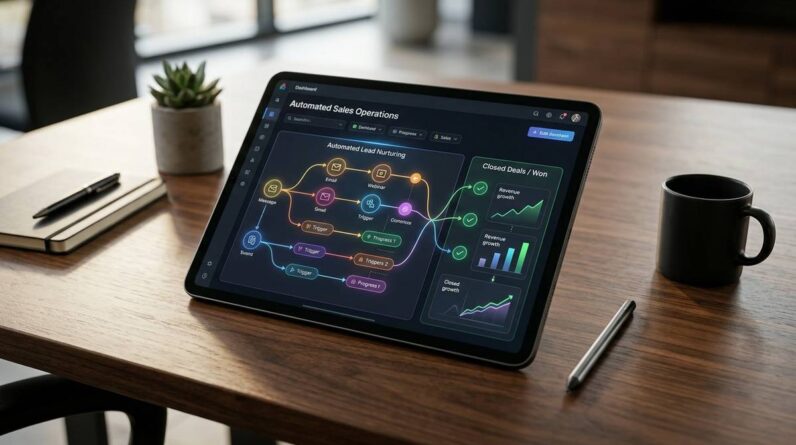
In the early days of starting a business, founder-led hustle is an essential superpower.
You personally answer every inquiry within minutes, hop on endless discovery calls, customize every client proposal from scratch, and manually chase down overdue invoices. That personal energy is often what gets a young company off the ground.
However, as your business grows, relying entirely on manual, founder-driven sales becomes your single greatest operational bottleneck.
When your sales pipeline depends completely on your physical presence and active hours, your revenue hits a hard mathematical ceiling. If you take a vacation, get sick, or need to dedicate two weeks to client fulfillment, your lead generation grinds to a halt. When you finally return to sales, your pipeline is bone dry, throwing your business back into the exhausting, stressful feast-or-famine revenue cycle.
Real business freedom and scalable revenue require transitioning from hero-dependent selling to system-dependent selling.
A well engineered sales system works quietly in the background twenty-four hours a day, seven days a week: educating cold prospects, filtering out unqualified tire kickers, presenting your value proposition, and closing transactions even while you sleep or focus on strategic product development.
In this step by step architectural guide, we will break down how to design, build, and deploy an automated sales system that produces predictable revenue without demanding your continuous presence.
The Difference Between a Salesperson and a Sales System
Before building automation tools, you must understand the structural difference between manual selling and systemized selling:
- Manual Selling relies on human memory, emotional energy, and real-time physical effort. It is inconsistent, difficult to delegate, and collapses under high volume.
- Systemized Selling relies on documented assets, automated triggers, and standardized conversion mechanics. It delivers your best sales pitch with flawless consistency to every prospect, gathers objective data, and scales effortlessly whether you handle ten leads or ten thousand leads.
Building a sales system does not mean replacing human relationships with cold, robotic spam. In fact, a great sales system enhances human connection by removing administrative friction, allowing you to spend your limited human hours exclusively with qualified, high-intent buyers who are already eager to work with you.
Component 1: The Automated 24/7 Prospect Education Engine
The traditional sales approach forces a human salesperson to repeat the exact same introductory presentation fifty times a month. You explain your company background, describe how your service works, answer the same five basic questions, and explain why your pricing is structured the way it is.
Repeating basic educational information on live calls is an enormous waste of expensive human capacity.
Your sales system should handle eighty percent of prospect education before a live conversation ever occurs.
Building Your Core Asset: The Video Sales Letter or Cornerstone Demonstration
Create one definitive, high-value visual presentation (typically fifteen to twenty-five minutes long) that systematically guides a prospective buyer through your complete methodology:
- The Problem Breakdown: Articulate the prospect current frustration with greater clarity and depth than they can express themselves.
- The Flawed Industry Alternatives: Explain logically why traditional solutions, competitors, or DIY approaches fail to produce lasting results.
- Your Unique Process or Mechanism: Introduce your proprietary framework, showing visually how your step by step system solves the root problem.
- Social Proof and Verifiable Case Studies: Showcase real-world client examples demonstrating measurable transformations.
- The Call to Action: Instruct qualified viewers on the exact next step to take to work with your team.
When prospects watch this asset before booking a call, they arrive pre-educated, pre-sold, and respecting your authority. You no longer have to convince skeptical strangers; you simply confirm mutual fit.
Component 2: The Self-Filtering Qualification Gate
One of the fastest ways to burn out a sales team is allowing unqualified prospects to book live calendar appointments.
Your sales system must include an automated qualification filter that protects your team calendar and sets clear boundaries:
- Implement Progressive Profiling Forms: Replace basic name-and-email forms with a multi-step intake questionnaire that captures critical buying signals: current revenue or budget, timeline for implementation, specific primary challenge, and decision-making authority.
- Transparent Investment Ranges: State your minimum engagement fees clearly on your scheduling page. If your services start at five thousand dollars, stating that threshold upfront politely filters out prospects looking for five-hundred-dollar discount work.
- Automated Routing Logic: Use calendar scheduling tools with conditional logic. Route qualified prospects directly to your senior closers, while routing disqualified leads to self-serve digital products, group workshops, or helpful free resources.
By automating qualification, your team spends their time closing high-margin deals rather than explaining why they cannot discount their fees.
Component 3: The Behavioral Email Nurturing Engine
When a prospect downloads a resource or views your presentation but fails to purchase immediately, manual sales reps usually send a couple of awkward check-in emails and give up.
An automated sales system deploys a structured, behavioral email sequence that continues nurturing the relationship for weeks and months.
The Five-Part Evergreen Sequence
- Email 1 (The Quick Win): Deliver the requested resource immediately, accompanied by an actionable tip they can implement in ten minutes.
- Email 2 (The Paradigm Shift): Challenge a common, mistaken industry belief and introduce your unique methodology.
- Email 3 (The Case Study Deep Dive): Break down a specific client story, highlighting the obstacle they faced and the exact steps used to overcome it.
- Email 4 (The Objection Crusher): Address the top three reasons prospects hesitate to invest (time, money, technical complexity) with calm logic and proof.
- Email 5 (The Direct Invitation): Extend a clear, time-sensitive invitation to take the next step, whether purchasing a starter package or booking a discovery session.
Because this sequence is triggered automatically based on subscriber actions, every lead receives your most persuasive arguments at the optimal psychological moment.
Component 4: Frictionless Checkout and Contract Mechanics
Deals frequently die at the finish line because the buying process is needlessly painful.
If closing a deal requires emailing a static PDF, waiting for the client to print, sign, scan, and email it back, and then manually sending an invoice through an accounting portal, you introduce massive friction that invites buyer remorse.
Your sales system should make paying you effortless:
- Digital Proposal Platforms: Use interactive web proposals where clients can review deliverables, select optional package tiers, sign electronically, and enter credit card or ACH payment details on a single secure screen.
- Automated Payment Processing: Eliminate manual billing by setting up recurring subscriptions, automatic deposit collections, and split-payment plans that charge client cards automatically on pre-set dates.
- Instant Onboarding Triggers: The moment payment is authorized, your system should automatically trigger a welcome email, generate a client portal account, and deliver a kickoff questionnaire. Delivering instant operational momentum reassures the client that they made an exceptional decision.
Component 5: Automated Pipeline Monitoring and Exception Alerts
An automated sales system does not mean running completely blind. You need clear visibility into system health without manually inspecting every record.
Set up automated dashboard alerts inside your CRM:
- High-Intent Activity Triggers: Receive a direct notification when a stalled prospect revisits your pricing page three times in twenty-four hours or watches your demonstration video to completion, allowing a sales rep to reach out at the moment of peak interest.
- Stalled Deal Alerts: Flag any active opportunity that sits in a specific stage longer than your historical average, prompting a targeted re-engagement campaign.
- Failed Payment Sequences: Automatically notify customers when a recurring credit card transaction fails, providing a secure self-serve link to update payment credentials without awkward collections calls.
Designing a Frictionless Evergreen Retargeting System
Even with exceptional automated education, ninety-five percent of prospects who visit your website or watch your demonstration video will not buy immediately.
An automated sales system incorporates automated retargeting that gently follows up with unconverted visitors across the web without manual sales intervention.
The Three-Phase Automated Follow-Up Funnel
- Days 1 to 7 (The Demonstration Phase): Retarget engaged video viewers with short, forty-second clips showcasing specific features, user interfaces, or practical client outcomes.
- Days 8 to 14 (The Social Proof Phase): Serve testimonial quote carousels, customer interview snippets, and third-party reviews to dismantle skepticism.
- Days 15 to 30 (The Direct Call-to-Action Phase): Present a risk-reversing guarantee, an invitation to a live Q&A session, or a low-barrier starter audit to encourage action.
By setting up these automated ad audiences inside your ad manager once, your marketing machine automatically nurtures every interested prospect for thirty days while you focus entirely on fulfilling client work.
Common Automation Pitfalls That Ruin Customer Trust
While automating your sales pipeline creates extraordinary leverage, avoid these three critical mistakes:
- Robotic Impersonation: Never use software bots that pretend to be a real human typing in live chat. Modern buyers spot fake live chat scripts immediately and feel deceived. Be honest about automated delivery.
- Premature Aggression: Sending eight sales emails in forty-eight hours immediately after someone downloads a free PDF destroys goodwill. Space your communications thoughtfully.
- Broken Handoffs: If an automated system promises a follow-up link or calendar booking, test the links every month. A broken confirmation link leaves prospective buyers feeling stranded.
Free Your Time to Build the Future of Your Business
A business that relies entirely on founder selling is not a scalable enterprise; it is a high-stress, self-employed job.
By building an automated sales system that educates prospects, filters out tire kickers, nurtures relationships through evergreen sequences, and streamlines closing mechanics, you create true commercial stability. Your revenue continues flowing smoothly whether you are in the office, traveling with your family, or developing your next big product breakthrough. Build the system once, refine it with real market data, and enjoy the lasting freedom of predictable, automated sales.
Key Operational Metrics to Monitor Your Automated Sales System
To ensure your automated sales engine remains healthy and profitable without daily intervention, monitor four vital health metrics on your weekly dashboard:
- Opt-in Conversion Rate: The percentage of landing page visitors who submit their information to enter your educational sequence.
- Asset Completion Rate: The percentage of subscribers who watch your core video sales letter or demonstration to the end.
- Lead-to-Call Booking Rate: The proportion of qualified prospects who schedule an appointment on your team calendar.
- Average Customer Acquisition Velocity: The average number of days that elapse from initial email opt-in to completed payment.